DSKY · Volume 15
DSKY — Volume 15 — Manufacturing the Impossible
How the program for the Moon was woven by hand, wire by wire, into permanence
15.1 About This Volume
Most of this series has been about ideas: the mathematics of inertial navigation, the architecture of a real-time operating system, the elegant negotiation between a pilot and a computer in the last seconds of a lunar descent. This volume is about something humbler and, in its way, more astonishing. It is about making. It is about the moment when all of that abstraction — the verified, frozen, exhaustively simulated flight software — had to leave the world of paper and become a physical object that could be bolted into a spacecraft and trusted with human lives.
The Apollo Guidance Computer was designed at the Massachusetts Institute of Technology’s Instrumentation Laboratory, the place that would later bear the name of its founder, Charles Stark Draper. But MIT did not build the machines that flew. Almost none of the AGCs that went to the Moon were assembled in Cambridge. They were built about fifteen miles away, in the brick-and-glass plants of the Raytheon Company in Waltham and Sudbury, Massachusetts — and the most remarkable part of them, the read-only memory that held the program itself, was not manufactured by machines at all. It was woven, by hand, by skilled women, over weeks of painstaking work, in a process closer to weaving a tapestry than to anything we would now recognize as building a computer.
Volume 5 told the story of what core rope memory was and why it was so dense and so permanent. This volume tells the story of who made it, and how, and what it cost in human attention. It is a story that the official histories under-told for decades, because the people at its center were factory women whose names rarely made it into the engineering reports. It deserves its own volume, because Apollo’s computer was not only a triumph of the silicon age. It was also, quite literally, a textile.
15.2 Raytheon: From a Cambridge Drawing Board to Flight Hardware
By the early 1960s Raytheon was already one of the great electronics firms of the Northeast, with deep roots in radar, microwave tubes, and missile guidance — it had built the guidance electronics for the Sparrow and would later be known to the public for the microwave oven. When MIT’s Instrumentation Laboratory won the very first major Apollo contract — signed in August 1961, before NASA had even decided how it would get to the Moon — the Lab took on the design of the guidance and navigation system. But the Lab was a research institution, not a factory. It could build a handful of prototypes; it could not turn out flight units to NASA’s schedule and NASA’s reliability standards. For that it needed an industrial partner, and Raytheon became the prime contractor for manufacturing the AGC.
This division of labor — a university laboratory designing, a defense contractor building — was characteristic of Apollo, and it created a constant, productive friction. The MIT engineers handed Raytheon drawings, specifications, and tolerances; Raytheon had to make those drawings reproducible on a production line, hundreds of times, with every unit identical to the last and every unit good enough to bet a crew on. The two organizations argued, refined, and re-argued the design for years. Many of the AGC’s most distinctive manufacturing choices — the welded interconnections, the potting compounds, the screening regimes — emerged from Raytheon’s need to make MIT’s clever design manufacturable and certifiable.
The numbers were never huge by commercial standards. Across the whole program, on the order of seventy-five Block I and Block II computers were built — flight units, plus the spares, ground-test articles, and trainers that any crewed program demands. This was not a consumer product rolling off by the million. It was closer to handcraft at industrial scale: small lots of an extraordinarily complex machine, each one inspected to a degree that would have been economically unthinkable for anything but a spacecraft.
15.3 A Bit Is a Wire’s Decision — Made by a Hand
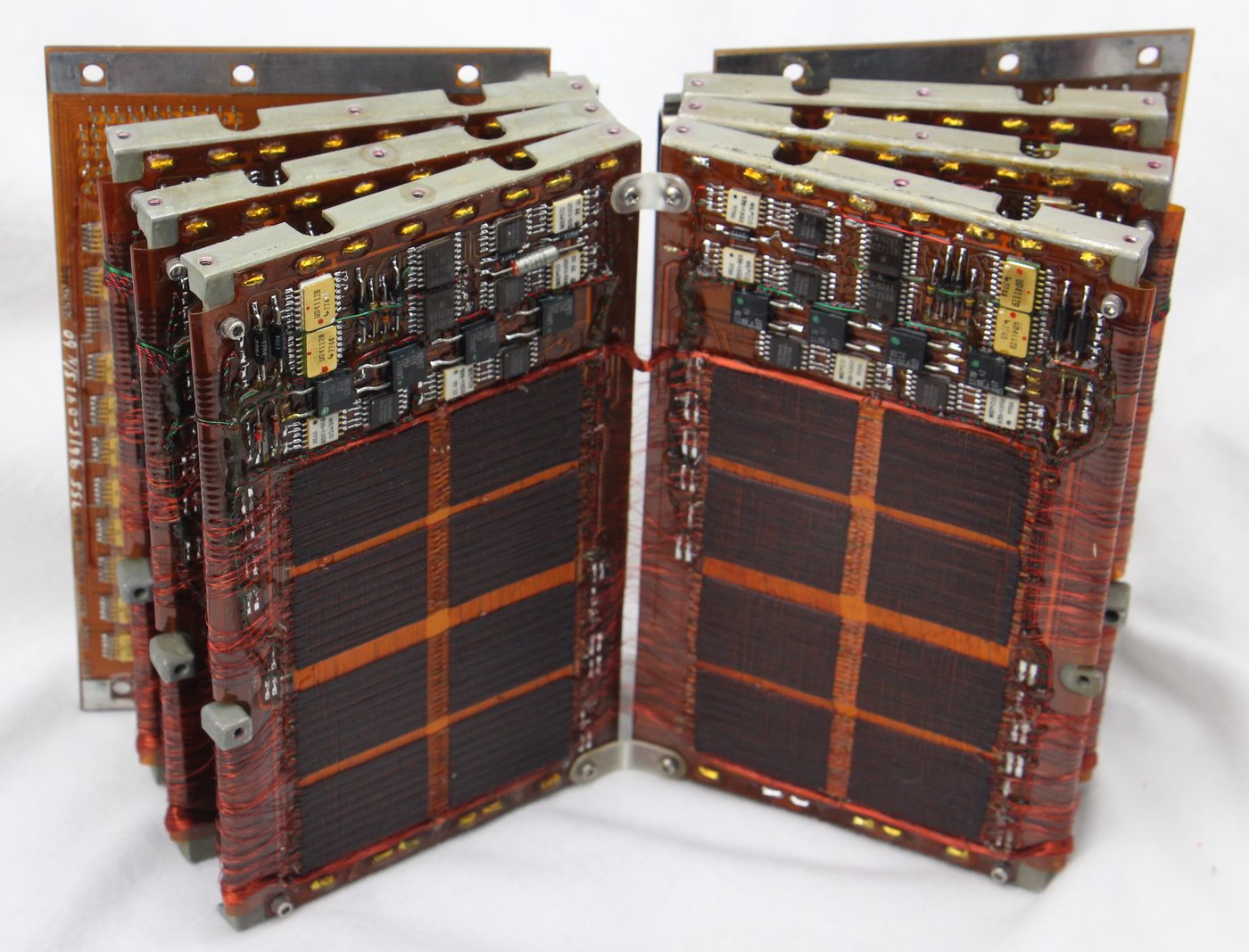
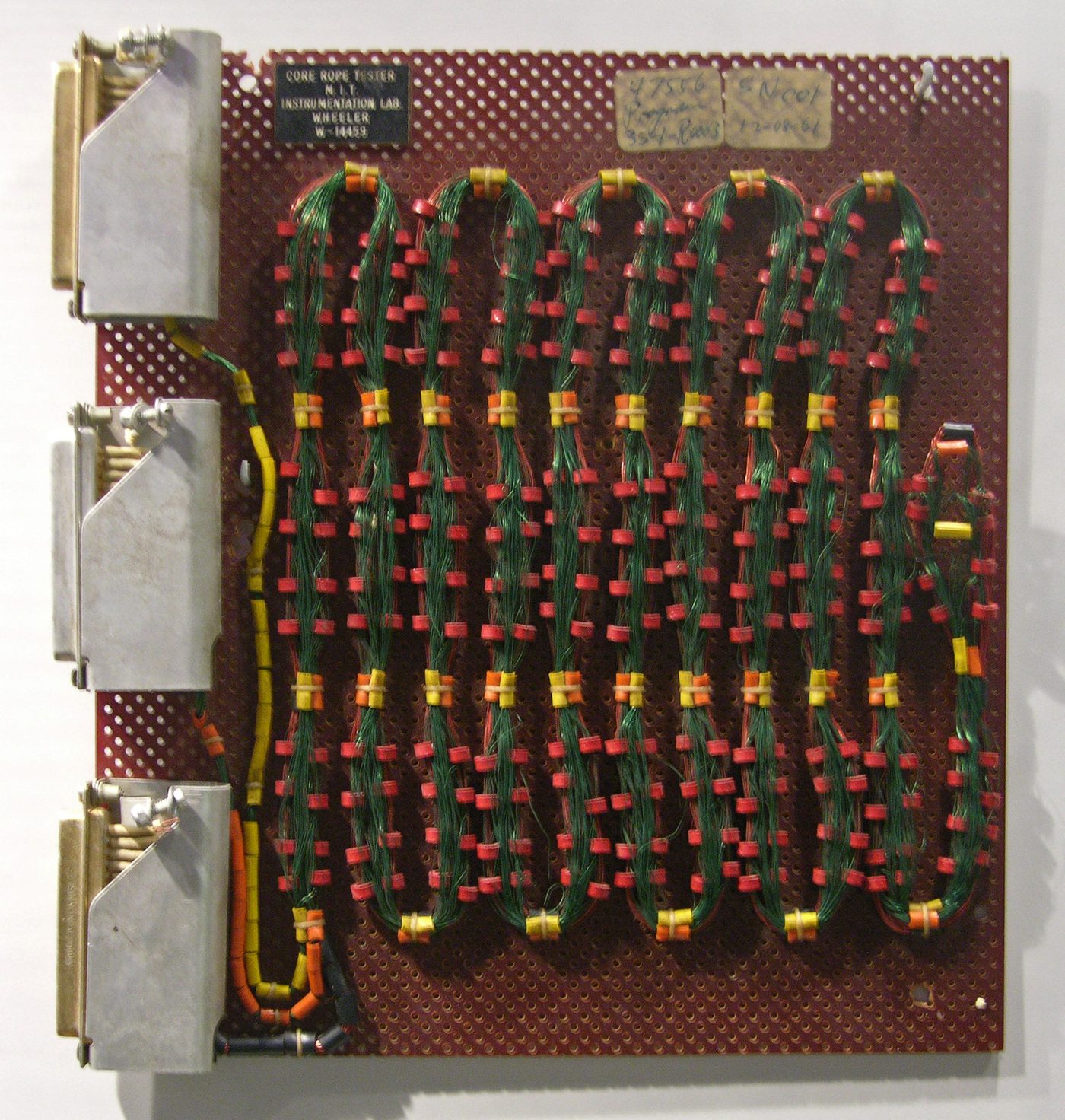
To understand the weaving, recall from Volume 5 the single decisive idea of core rope memory. In ordinary magnetic-core memory, each tiny ferrite ring — a “core” — stores exactly one bit, set by the direction it is magnetized. Core rope inverts that relationship. In a rope, the question for every bit is not how is this core magnetized but does this particular wire pass through this particular core, or around it? A wire threaded through a core reads as a one; a wire routed around it reads as a zero. Because you can thread many different sense wires through the same core, each core becomes a shared switch broadcasting a whole pattern of bits. In the AGC’s Block II rope, up to 192 wires passed through or around a single core, so each core held 192 bits — and six rope modules together stored 36,864 sixteen-bit words, the canonical “36K” of fixed program that flew to the Moon.
That is a beautiful idea on a whiteboard. On a factory floor it meant that every bit in the program corresponded to a physical decision a human had to make with her hands: this wire goes through this core, that wire goes around the next. A finished rope contained roughly half a mile of fine copper wire, and the route of every inch of it had been dictated, bit by bit, by the compiled program. The software was not loaded into the memory. The software was the memory — its ones and zeros frozen as the literal geometry of wire and ferrite, soon to be sealed in epoxy and made as permanent as anything human beings have ever built.
15.4 The Rope Weavers
The weaving was done at Raytheon’s Waltham plant, and it was done overwhelmingly by women. Many were recruited specifically for the fineness and steadiness of their hands — drawn from the textile mills that still dotted eastern Massachusetts, and from the nearby Waltham Watch Company, the famed precision-watch manufacturer whose workers were accustomed to assembling tiny, exacting mechanisms. These were the same regional pools of skilled female labor that, in an earlier age, had wound watch springs and run looms. Now they were asked to weave a computer’s mind.
The engineers nicknamed the result “LOL memory” — for the “Little Old Ladies” who wove it. The name was affectionate, and it has become one of the most-repeated anecdotes in Apollo lore. It is worth a small honest caveat: historians and engineers who have gone back to the original record — among them Ken Shirriff, who reverse-engineered surviving rope hardware — have noted that it is not entirely certain how widely the “LOL” tag was used at the time, versus how much it was attached to the work later as the story was retold. What is not in doubt is the substance behind the nickname: the ropes were woven by hand, by experienced women, with a precision that no automated process of the era could match.
How did the weaving actually work? It was a semi-automated process — a marriage of a machine and a human, in which neither could have done the job alone.
The compiled, verified, frozen program — the output of the long software process described in Volumes 10 and 11 — was translated into a control medium the machine could read: a punched paper tape (in some descriptions, punched cards) encoding, for every wire and every core, the binary pattern of through-or-around. A weaving fixture read that tape and used it to drive the work physically. The machine held the matrix of cores and, for each step, positioned an aperture — effectively pointing at one specific core and signaling the weaver whether the wire was to go through it (a 1) or around it (a 0). It was, in effect, the program itself reaching out and telling the worker where to put the next stitch.
The weaver then did the part no machine could do. Holding a long hollow needle trailing the sense wire, she physically threaded it through the indicated aperture — through the core for a one, around it for a zero — then moved to the next, and the next, following the program’s pattern the way a weaver follows a chart, bit after bit, address after address, until a complete strand of the program had been laid into the lattice. Then the next wire began. Half a mile of it, all told, threaded by hand.
The pace was glacial by any modern standard. Wiring a single rope module took on the order of eight weeks of skilled labor, and a finished module cost roughly $15,000 in mid-1960s dollars — a sum worth well into six figures today. The work demanded the kind of sustained, error-free attention that is exhausting precisely because it cannot be hurried.
And the stakes of a slip were brutal. This was not a keystroke that could be deleted, not a line of code to be re-compiled. A wire threaded through the wrong core — a single one mistaken for a zero — could mean unpicking weeks of work, or, if caught too late, scrapping the module entirely and starting again. There was no patch, no quick fix. The weaver’s hand was the last stage between the verified software and the spacecraft, and her accuracy was, in the most literal sense, load-bearing. The program was woven into permanence, and so was every mistake.
15.5 The Women Whose Labor Made the Software Real
For a long time the people at the center of this story were nearly invisible in the official histories. The engineers were named; the women on the factory floor were “the Little Old Ladies,” a charming collective noun that erased them as individuals even as it celebrated them as a group. Recent work by historians, by the Smithsonian, and by Draper Laboratory’s own outreach has begun, belatedly, to restore some of those names and faces.
The most famous figure in the weaving story is not herself a weaver but the software lead who handed the code over to be woven: Margaret Hamilton, who directed the Apollo flight-software effort at the Instrumentation Laboratory and who was known, in a phrase that captures the whole handoff, as the “Rope Mother.” The title is exact. Hamilton’s team wrote and proved the code; the rope mother’s job was to shepherd that code through the gauntlet of review and into the form in which it would be physically woven. (We deliberately avoid here the single over-reproduced photograph of Hamilton beside a stack of listings; her story runs through Volumes 10 and 11, and the program she guarded is the subject of this entire series.)
But the rope mother’s code meant nothing until other hands made it real. The weavers themselves are only now being recovered from the record. Names that survive in accounts gathered by the Smithsonian and by science journalists include weavers and inspectors such as Vernell Norman, Caroline Butler, Helen Lennon, Edna Walcott, and Mary Julian — ordinary names of working women whose extraordinary care put the program into the machine. One Raytheon worker who has spoken about the era, Mary Lou Rogers, recalled the relentlessness of the inspection: every component, she remembered, had to be examined by three or four different people before it could be stamped off as good. The documentation of any single individual’s contribution is thin — that thinness is itself part of the story — and any roster should be read as a small, recovered fragment of a much larger, mostly anonymous workforce. But the shape of the truth is clear: a great deal of the most exacting, mission-critical manufacturing of the Apollo computer was performed by women, both on Raytheon’s floor and in the Instrumentation Laboratory’s programming rooms, and their skilled labor is what allowed the software to exist as flight hardware at all.
There is a further, less comfortable thread to the same story. The integrated circuits at the heart of the AGC’s logic — the silicon-age half of this machine — were themselves built in large part by women, and by women whose contribution was even more thoroughly erased. Fairchild Semiconductor, a key supplier of the AGC’s logic chips, opened a plant in Shiprock, New Mexico, on the Navajo Nation in 1965, where a workforce that was overwhelmingly Navajo women assembled and tested integrated circuits. In its own promotional materials Fairchild explicitly likened the women’s chip-assembly work to traditional Navajo rug-weaving — a comparison that romanticized their skill while paying them little and crediting them less. The parallel is uncanny and worth sitting with: at both ends of the AGC — the woven copper of its memory and the woven silicon of its logic — the literal handwork was done by women, framed by the men who managed it as a kind of feminine craft, and largely left out of the heroic narrative that followed.
15.6 Zero Defects: The Culture of Reliability
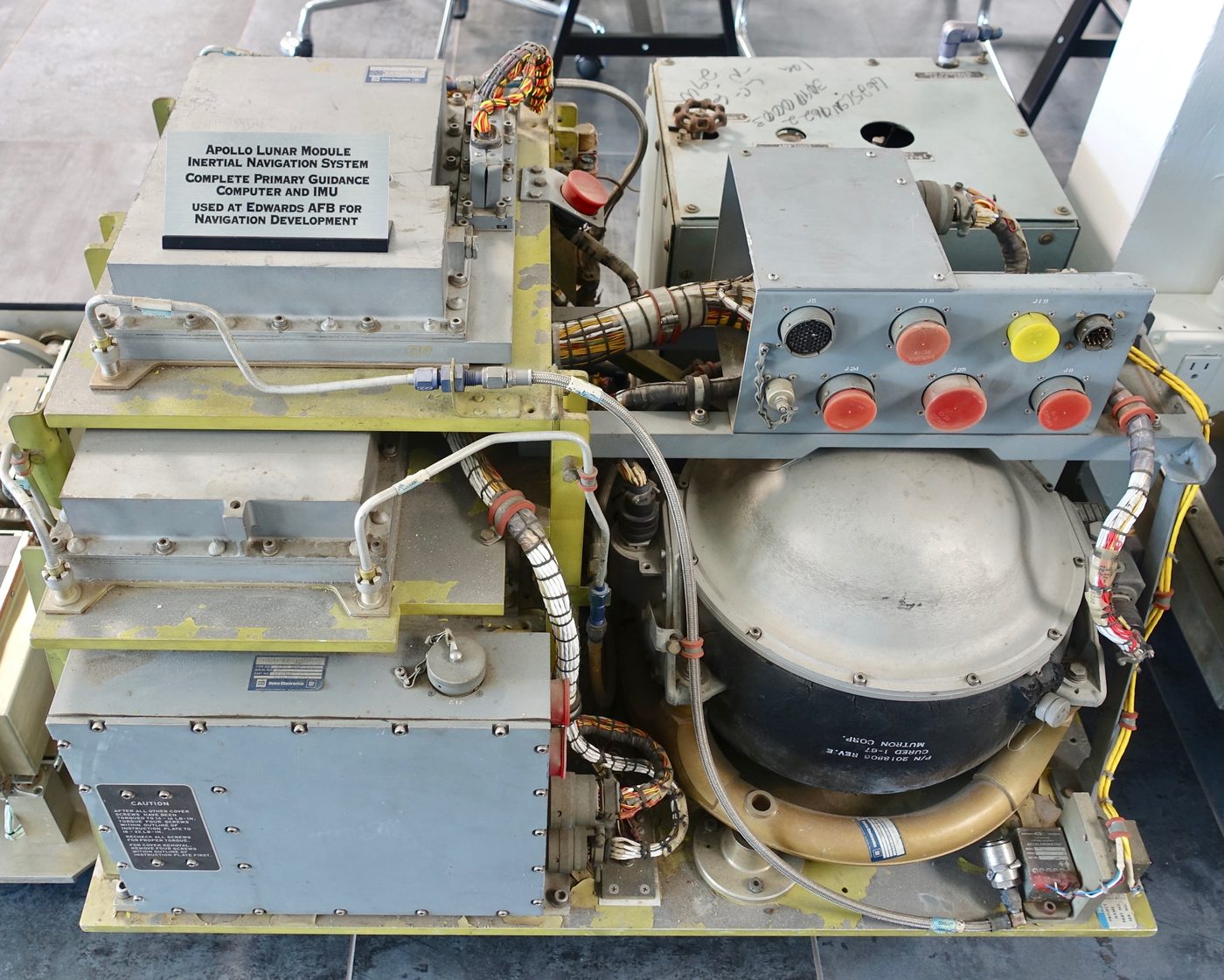
A spacecraft computer has a property that almost no consumer product shares: a single failure can kill the crew. There is no roadside assistance a quarter of a million miles out. Every design and manufacturing decision in the AGC was bent toward one overriding goal — do not fail — and Raytheon built a quality-and-reliability culture around that goal that was as much a part of the product as the wire and the silicon.
The headline number tells the story: the AGC achieved a mean time between failures on the order of 70,000 hours, an almost unheard-of figure for a complex digital computer of the 1960s, and across the entire crewed program no AGC ever failed in flight in a way that endangered a mission. That reliability was not luck. It was manufactured, deliberately and expensively, through a stack of practices that together amounted to a zero-defect philosophy.
It began with the parts. Individual components — transistors, the integrated-circuit flat-packs, resistors, the ferrite cores themselves — were not simply bought and installed. They were screened: subjected to burn-in, thermal cycling, and electrical testing designed to provoke the weak ones into failing on the bench rather than in space. Components that survived were tracked; those that failed were analyzed. Raytheon and its partners pioneered the use of some of the first modern clean rooms precisely because they had learned, painfully, that particulates and trapped moisture sealed into a part during assembly could quietly ruin it. Cleanliness was not housekeeping; it was reliability engineering.
It continued in the assembly itself. The AGC’s logic interconnections were resistance-welded rather than soldered — a more demanding, more repeatable joining method chosen because a properly made weld is more reliable than a solder joint and far less prone to the cold-joint failures that plague hand soldering. The modules were potted in epoxy to immobilize everything against the violence of launch.
And it was enforced through inspection and traceability. Mary Lou Rogers’s memory of every component passing under three or four sets of eyes was not an exaggeration; it was the system working as designed. Each step was inspected, documented, and signed off, so that the provenance of every part and every operation could be traced. Failures, wherever they appeared, had to be reported and analyzed — a formal closed-loop discipline in which no anomaly was allowed to go unexplained. This was the same relentless self-checking that ran through the AGC’s software — the parity bits, the restart logic, the priority scheduler of Volume 12 — expressed now in the manufacturing. The machine was built by a culture that assumed, at every level, that anything unverified was a latent way to kill the crew.
15.7 The Freeze, the Cost, and the Marriage of Eras
The weaving did not just shape the factory. It reached all the way back up the project and reshaped how the software itself was managed, because a rope has a manufacturing lead time. If the program must be physically woven and then tested over a span of weeks before it can fly, then there is an absolute, immovable deadline by which the code must be finished, frozen, and handed to manufacturing. You cannot patch a rope on the launch pad. You cannot push a fix the night before. Once the weave begins, the software for that flight is set in copper — exactly as permanent as the women’s needles have made it.
This is the hard freeze deadline that haunts Volumes 5 and 10, and it is the reason the Instrumentation Laboratory built such a formidable apparatus of review and simulation around the flight code. The permanence of the memory and the rigor of the software were cause and effect: rope memory made sloppiness physically impossible to ship. Every flight had its rope, and every rope had its weavers, working weeks ahead of a launch on a program that had to be perfect before they began — because they were the ones who would make any imperfection eternal.
Step back and look at the whole machine, and you see one of the strangest and most beautiful juxtapositions in the history of technology. Here was a computer at the absolute leading edge of the silicon age — among the very first machines anywhere to bet its logic entirely on the brand-new integrated circuit (Volume 4), a device so unproven that Apollo’s enormous order helped create the commercial IC industry itself. And the program that ran on those futuristic chips was stored in a medium that would not have looked out of place in a textile mill — copper thread pulled through ferrite by a woman with a needle, half a mile of it, eight weeks at a time. The most advanced computer of its day kept its mind in a tapestry.
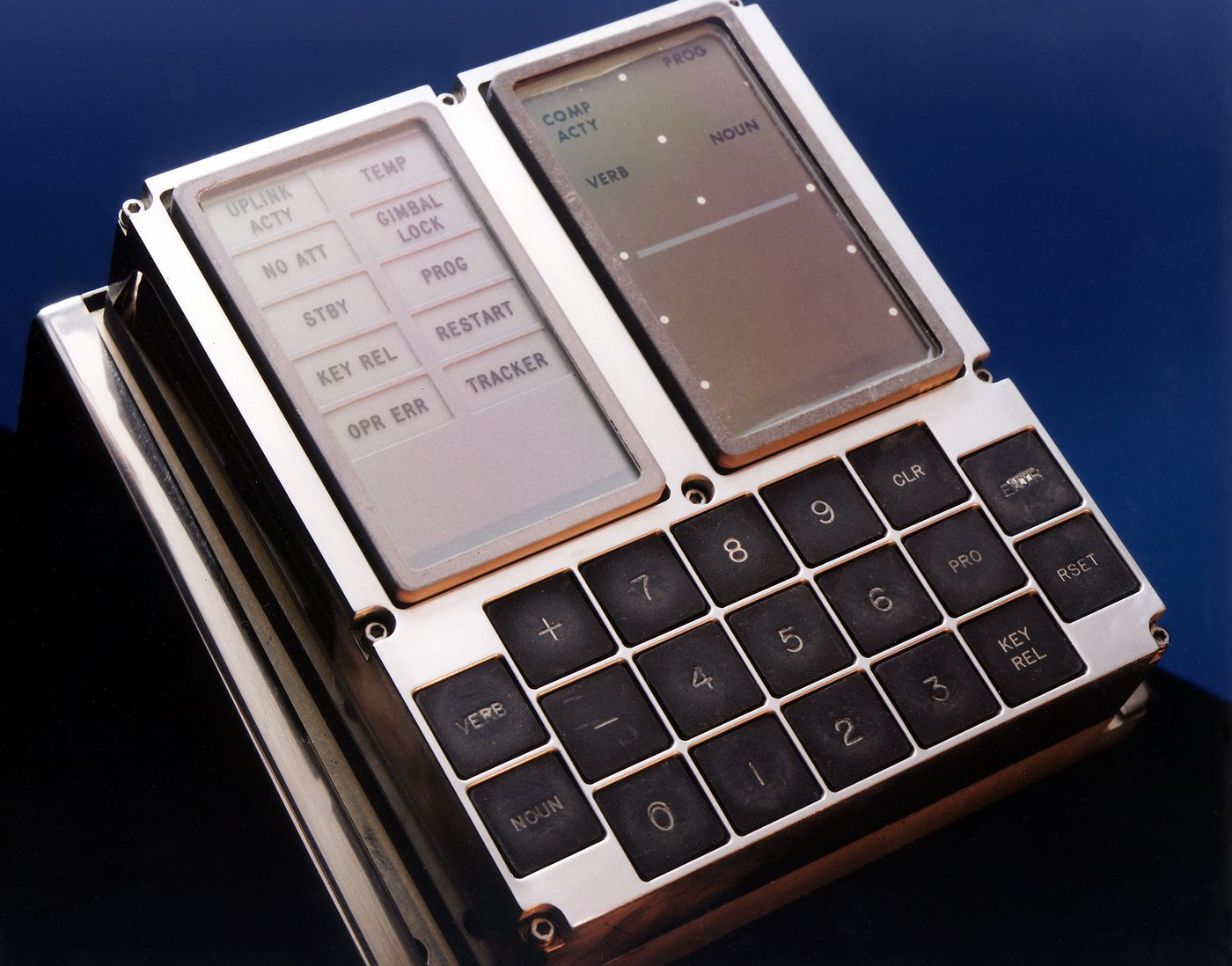
That juxtaposition is the point of this volume. We are accustomed to telling the Apollo computer story as a story of engineers and ideas — of Draper’s gyroscopes, of Hal Laning’s executive, of Don Eyles’s landing code. All of that is true and all of it matters. But none of it would have left the ground without the other half of the story: the factory in Waltham, the watch-company hands, the eight-week weave, the three-or-four sets of inspecting eyes, the women at Shiprock building the silicon, the rope mother guarding the freeze. The AGC was not only invented. It was made — and it was made, to an extent the heroic narrative long ignored, by the skilled and patient hands of women turning a verified program into a physical, permanent, flight-ready thing.
Apollo’s computer was a product of the silicon age and of an almost medieval handcraft at the very same time. Both were necessary. Neither, alone, could have reached the Moon.
Next — Volume 16: Legacy — How Apollo Helped Build the Modern World.
Comments (0)