DSKY · Volume 5
DSKY — Volume 5 — Core Rope Memory: Software You Could Hold
How Apollo's program became a physical object — woven in copper and ferrite, permanent as a fossil
5.1 About This Volume
Every other volume in this series treats software as something abstract — instructions, routines, verbs and nouns, the logic that flickered behind the DSKY’s display. This volume is about the one place in the whole Apollo story where software stopped being abstract and became a thing you could pick up and hold in your hands. The Apollo Guidance Computer did not load its program from a disk or a tape, and it did not hold that program in any kind of electronics that could forget. The program was woven into the machine, wire by wire, by human hands, and once woven it was as permanent as anything humanity has ever built. Drop it, freeze it, bake it, cut the power for a decade — the bits stayed exactly where they were.
This is the story of core rope memory: the read-only store that held the AGC’s program; its read/write cousin, the small bank of erasable core memory that served as scratchpad; and the strange, beautiful consequence of building a computer whose software had to be manufactured like a tapestry. We will keep this volume focused on the technology — how a bit was encoded by a wire, why this scheme was so astonishingly dense, and why it was so reliable. The human story of the women who did the weaving is developed more fully in Volume 15; here we only introduce them, because you cannot explain rope memory honestly without them.
5.2 The Problem: A Program That Could Not Be Allowed to Forget
Consider what NASA was asking of the AGC’s memory in the early 1960s. The program that guided astronauts to the Moon and back had to survive the most violent transport humans had ever devised. At launch, the Saturn V battered its payload with vibration and acoustic energy fierce enough to shake bolts loose and crack solder joints. In flight, the spacecraft swung through temperature extremes, hard vacuum, and a steady sleet of radiation. The computer could be powered down and back up. And through all of it, not one bit of the program could change. A single flipped bit in the guidance equations could put the spacecraft into the wrong orbit, or worse.
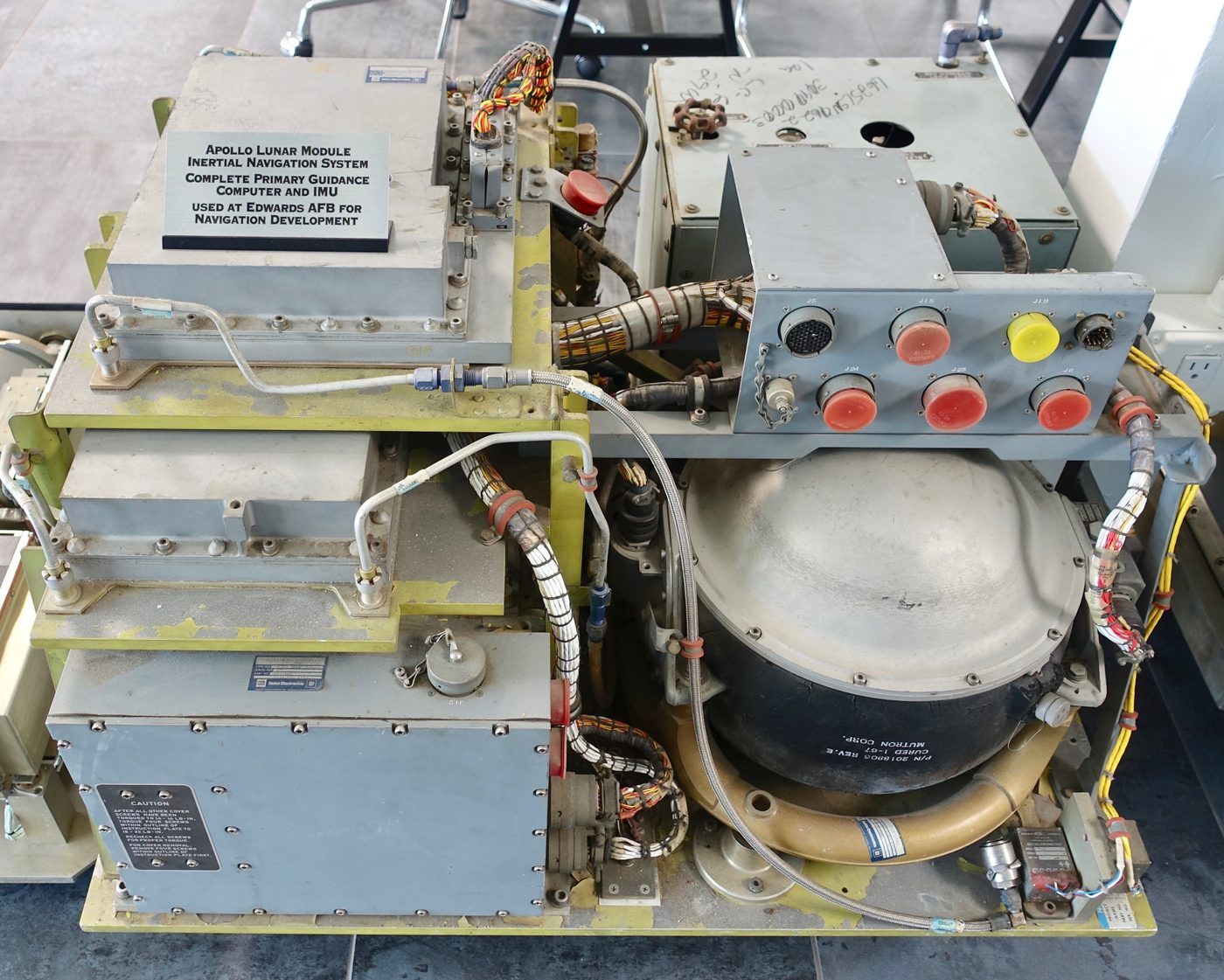
Early-1960s read/write memory was nowhere near equal to this. Semiconductor RAM as we know it did not yet exist in any practical, space-qualified form. The available read/write technology was magnetic-core memory, and while it was rugged, it was also volatile in the sense that mattered: it could be written, which meant it could be corrupted — by a glitch, a stray current, a software bug, a cosmic ray. You would never trust the irreplaceable, life-critical guidance program to memory that could be overwritten. What the AGC needed for its program was memory that was, by physical construction, incapable of being changed at all: read-only, permanent, immune to power loss, and dense enough and light enough to fit in a box the size of a couple of stacked briefcases.
The answer was to make the program not stored in the hardware but built into it. The bits would not be electrical states that could decay; they would be the physical routing of wires, fixed in epoxy. To change a bit you would have to physically rebuild the memory. That is core rope memory.
5.3 Core Rope Memory: A Bit Is a Wire’s Decision
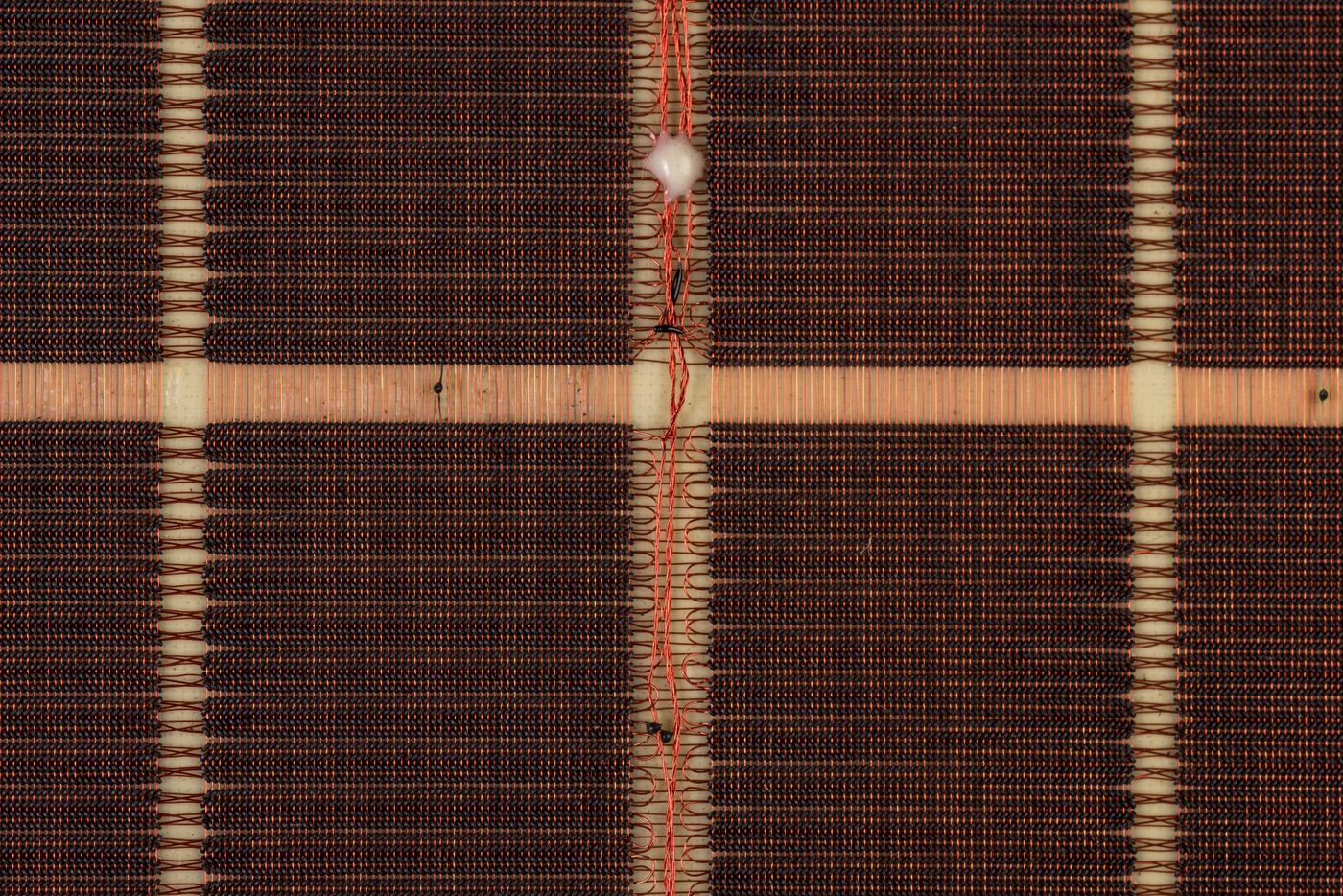
The principle is so simple it sounds like a riddle, and so clever it took the era’s best engineers to exploit it. Magnetic-core memory of every kind is built from tiny doughnut-shaped rings — cores — of ferrite, a hard magnetic ceramic. Drive a strong enough current through a wire threaded through a core, and you flip the core’s magnetic field from one direction to the other. When that field flips, it induces a small voltage pulse in any other wire that also passes through that same core. That induced pulse is the heart of the read operation: a flipping core “speaks” to the wires running through it, and stays silent to the wires that do not.
Core rope memory exploits this with one decisive trick. To store the program, the engineers ran a set of sense wires — the wires that carry data out — and, for each address, they pulsed a particular core to flip it. The question for every single bit was simply this:
- Does this sense wire pass through this core? If yes, when the core flips, the wire picks up a pulse — that bit reads as a 1.
- Does this sense wire instead route around the outside of the core? If so, the flipping core induces nothing in it — that bit reads as a 0.
That is the entire encoding. A one is a wire threaded through a ring; a zero is the same wire detouring around it. The information lives in the topology of the weave — which wires pass through which cores — and not in any changeable electrical state. There is nothing to forget. The program is, quite literally, the wiring diagram.
5.3.1 Why It Was So Dense: Many Wires Through One Core
Here is the part that made rope memory not just permanent but practical for spaceflight. In ordinary read/write core memory, each core stores exactly one bit — the core is either magnetized one way or the other, and that single magnetic state is the datum. Cores are small, but one bit per core puts a hard ceiling on density.
Core rope inverts the relationship. Because a 1-or-0 is decided by whether a given wire threads a given core, you can run many different sense wires through the same core, each one carrying a different bit. In the AGC’s Block II rope, engineers threaded up to 192 wires through a single core, so each core held 192 bits — twelve 16-bit words — rather than one. The core is no longer the storage element for a bit; it is more like a shared switch that, when fired, broadcasts a pattern of ones and zeros to all the wires woven around it. This multiplied the storage density by roughly two orders of magnitude over conventional core RAM, reaching on the order of a couple of thousand bits per cubic inch including the supporting drive and sense circuitry — extraordinary for the early-to-mid 1960s, and exactly the kind of density-per-gram that a spacecraft demands.
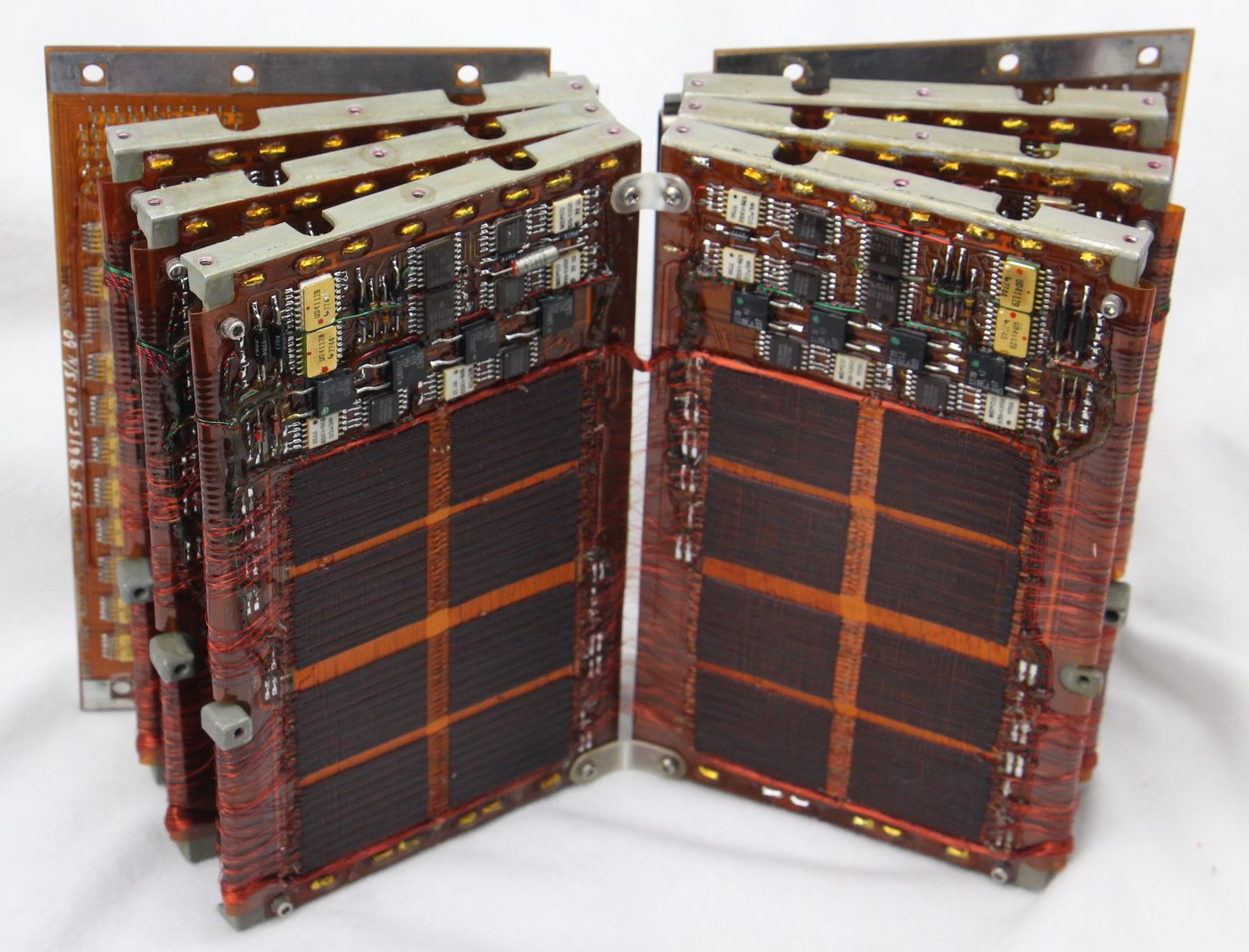
The arithmetic of the Block II machine falls straight out of this. Each rope module packed 512 cores, each holding 192 bits — 98,304 bits, or 6,144 sixteen-bit words, per module. The AGC carried six such modules. Six modules × 6,144 words = 36,864 words of fixed program memory — the canonical “36K” of rope ROM in the computer that flew to the Moon. A single finished rope used something like a half-mile of fine wire, all of it threaded by hand.
5.4 The Word: Fifteen Bits and a Watchman
A word in the AGC was 16 bits wide, but only 15 of those bits carried data. The sixteenth was a parity bit — a watchman. Parity is the simplest possible error check: the hardware sets that extra bit so that the total number of 1s in the word is always odd (the AGC used odd parity). Every time a word was read, the computer counted the bits; if the count ever came out even, something had corrupted the word, and the machine knew it. In rope memory, where the bits were physically immutable, parity guarded mostly against transient read errors and hardware faults rather than data rot — but it was part of the same philosophy of relentless self-checking that ran through the whole AGC design. The program could not lie to itself without being caught.
5.5 Woven by Hand: The Little Old Ladies
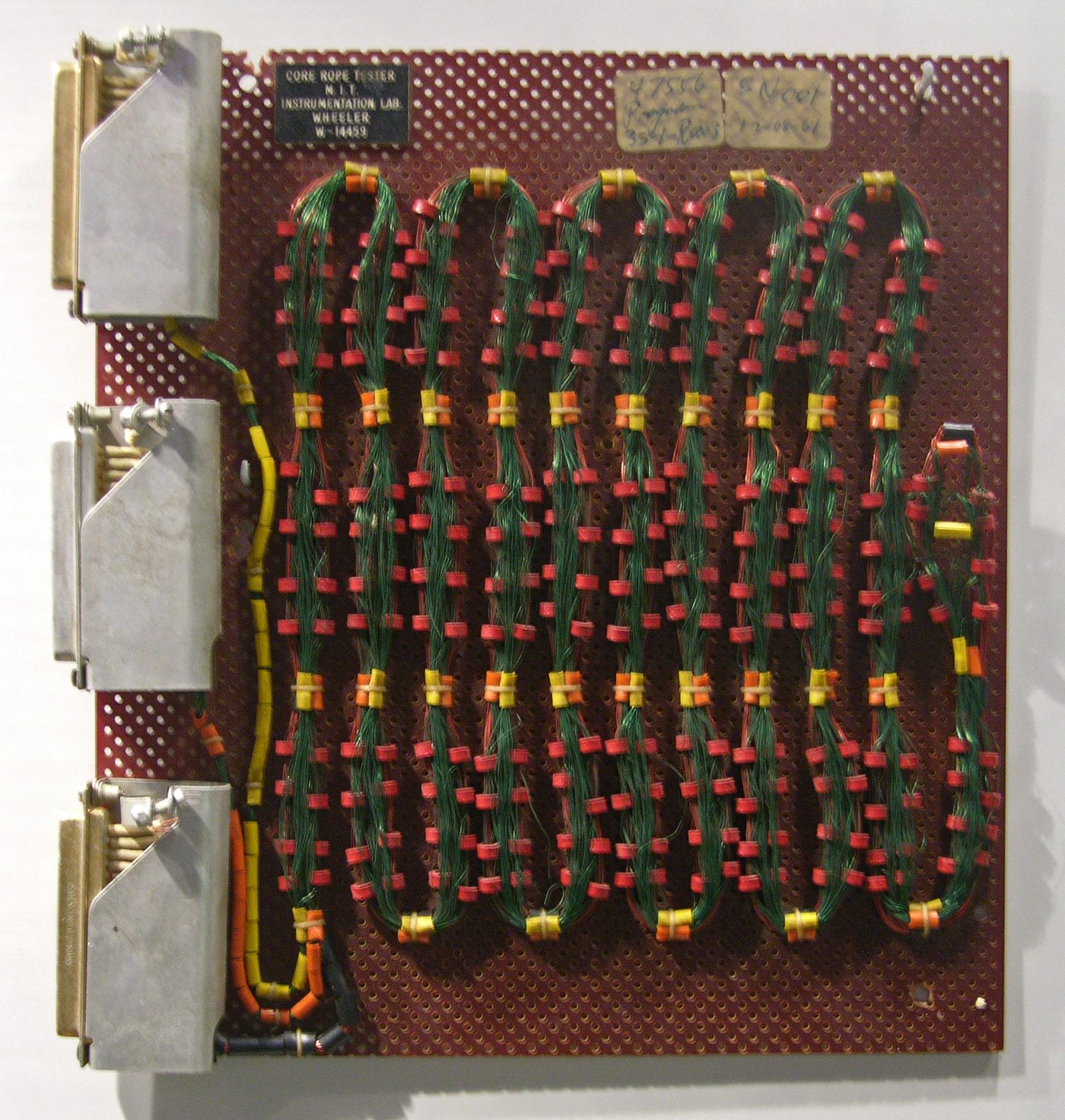
A rope did not come out of a machine. It came out of a factory floor at Raytheon, in Waltham, Massachusetts, where it was woven — and that word is exact — by skilled human beings, overwhelmingly women, many recruited for their fine-motor skill from the region’s textile mills and from the Waltham Watch Company. Working from printouts of the programmers’ compiled and verified code, a weaver guided each sense wire either through the aperture of a given core or around it, bit after bit, address after address, following the program’s binary pattern as if it were a knitting chart. The engineers nicknamed the result “LOL memory” — for the Little Old Ladies who made it — and the affectionate name stuck.
The work was painstaking beyond easy description. Threading a single rope took on the order of eight weeks, and a finished module cost roughly $15,000 in period dollars. A mistake was not a keystroke to be deleted; a wire threaded through the wrong core could mean unpicking weeks of work, or scrapping the module. The nickname later applied to Margaret Hamilton — the software lead sometimes called the “rope mother” — captures the relationship precisely: the programmers wrote and proved the code, and then it was given over to the weavers to be made physical, a handoff from the abstract to the literally hand-made. The fuller human story — who these women were, how the testing worked, the dignity and pressure of the job — is the subject of Volume 15. What matters technologically is this: the AGC’s software existed, in its flight form, as a woven textile of copper and ferrite.
5.6 The Freeze: When Software Has a Manufacturing Lead Time
This is where rope memory reached out of the hardware lab and reshaped the entire software project. If your program must be physically woven and then tested over a span of weeks before it can fly, then there is an absolute, unmovable deadline by which the code must be finished, frozen, and handed to manufacturing. You cannot patch a rope on the launch pad. You cannot push a fix the night before. Once the weave begins, the software for that flight is, in the most literal sense, set in copper.
The consequence was a discipline that modern software engineers can only envy and wince at in equal measure. Every line that would fly had to be written, reviewed, simulated, and proven correct well in advance of the weave. There was no “we’ll fix it in the next release” — the next release was a different rope, eight weeks and a small fortune away. This hard freeze forced the rigor, the exhaustive simulation, and the formal review process that the MIT Instrumentation Laboratory built around the flight code (the subject of Volumes 10 and 11). The permanence of the memory and the rigor of the software were not two separate facts; they were cause and effect. Rope memory made sloppiness physically impossible to ship.
It is worth sitting with the strangeness of that. In an age when we deploy software updates many times a day, the Apollo program shipped code with the lead time and irreversibility of casting a bronze statue. The medium enforced the message.
5.7 Erasable Memory: The Working Scratchpad
The program was permanent — but a guidance computer cannot run on read-only memory alone. It must add, store intermediate results, hold the spacecraft’s changing state, track the ever-updating numbers of an actual flight. For that, the AGC carried a much smaller bank of conventional read/write magnetic-core memory: the erasable store, roughly 2,048 words (the canonical “2K”) in Block II.
This erasable memory was coincident-current core RAM — the classic design of the era, and the one most people picture when they hear “core memory.” Cores sat at the intersections of a grid of fine wires; to address one core you drove half the necessary current down its row wire and half down its column wire, so that only the single core at the crossing point — receiving the full current from both — actually flipped. This “coincident current” trick let a two-dimensional grid of wires address any individual core without a dedicated wire per bit.
Reading this kind of memory had a famous quirk: it was destructive. To read a core, you forced it to a known magnetic state and watched whether it flipped (which told you what it had held) — but the act of reading erased the value in the process. So every read was immediately followed by a rewrite, the hardware writing the just-read value straight back into the core. Read-and-rewrite was simply how the machine worked; the scratchpad healed itself on every access. This is the working memory where the AGC kept its variables, its stack, its sense of where the spacecraft was and where it was going — small, fast for its day, and endlessly rewritten as the flight unfolded.
5.8 Two Memories, Two Philosophies
So the AGC carried two radically different kinds of memory side by side, and the contrast is the whole point:
- Fixed (rope) memory — ~36,864 words. Read-only, woven by hand, physically permanent, immune to power loss and corruption. This held the program: the guidance equations, the executive, the routines behind every DSKY verb and noun. Software cast in copper and ferrite.
- Erasable (coincident-current) memory — ~2,048 words. Read/write, destructive-read-and-rewrite, fast and flexible but volatile in use. This held the changing state of the flight: the scratchpad, the variables, the numbers that lived and died in seconds.
Eighteen-to-one in favor of permanence. The machine devoted the overwhelming majority of its memory to things that could never change, and only a small reserved corner to things that constantly did. That ratio is itself a statement of values: in a life-critical real-time system, the trustworthy, immutable bedrock should dwarf the mutable working space.
5.9 “Software You Could Hold”
There is a reason this volume is titled the way it is. We are used to thinking of software as the most ephemeral thing in engineering — a pattern of charge, a file, a download, gone the instant the power fails. Apollo’s flight software was the opposite. It was an object. It had weight and dimension. It was manufactured on a factory floor over weeks, by named human beings, and you could cut one open and trace, with a magnifier and patience, every single bit of the program by following where each wire went. The Moon-landing code did not reside in a memory; it was a physical artifact, and copies of those ropes survive today in museums, still holding — with perfect fidelity, half a century on, no power required — exactly the program that flew.
Rope memory was a solution born of necessity: the only way, in its moment, to make a program dense enough, light enough, and above all permanent enough to trust with human lives in deep space. But it became something more than a workaround. It turned software into hardware, discipline into a manufacturing schedule, and the abstract logic of guidance into a thing you could weigh in your hand. Of all the technologies that carried Apollo to the Moon, few are as quietly astonishing as this: a program you could not edit, could not crash, and could not lose — because it was woven, like cloth, into being.
Next — Volume 6: Inside the AGC — Architecture & Instruction Set.
Comments (0)