DSKY · Volume 9
DSKY — Volume 9 — Verbs and Nouns: The Language of Apollo
Sixteen keys, two-digit words, and a grammar that flew to the Moon
9.1 About This Volume
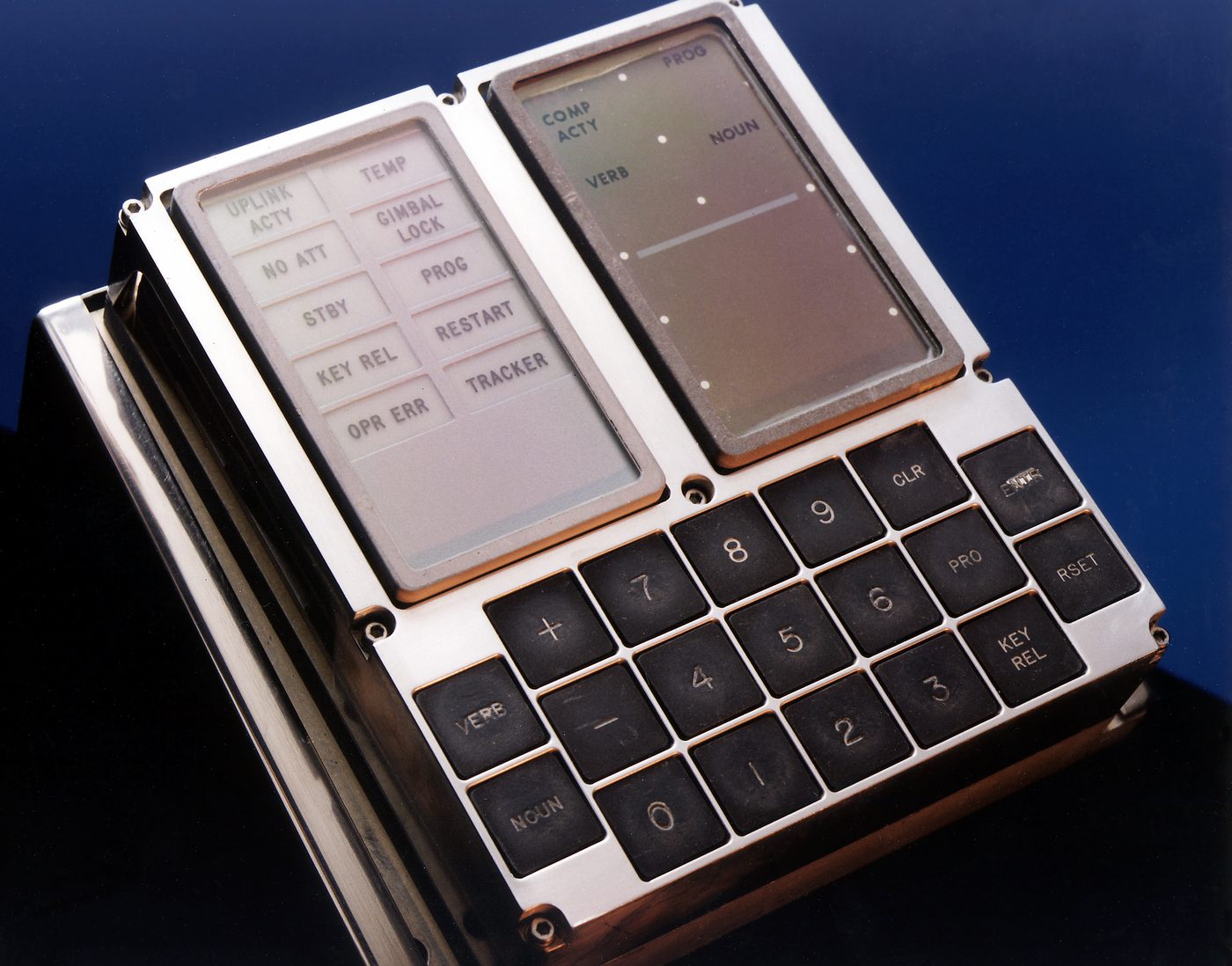
Every machine that humans operate has to be talked to somehow. The Apollo Guidance Computer (AGC) had to be talked to through one of the most constrained interfaces ever flown: a numeric keypad of sixteen keys and three small electroluminescent number registers glowing a particular shade of green. There was no keyboard full of letters, no screen of text, no mouse, no menus. There was no room — not on the instrument panel, not in the computer’s tiny memory, not in the budget of weight and power that ruled everything aboard a spacecraft.
And yet the crews of Apollo flew that interface to the Moon and back, nine times to lunar orbit and six times to the surface, by speaking to the computer in a language of verbs and nouns. This volume is about that language: where it came from, how its grammar worked, what the astronauts actually keyed during the most dangerous minutes of the program, and why a scheme its own inventors regarded as a temporary engineering hack turned out to be one of the most durable and admired pieces of user-interface design of the twentieth century.
Volume 8 described the physical panel — the keys, the lamps, the green registers, the difference between the Command Module’s two DSKYs and the Lunar Module’s one. This volume picks up where the hardware leaves off and explains the grammar that ran across it. Volumes 12 and 13 will then put that grammar to work minute by minute during the descent to the lunar surface, where the verbs and nouns of this chapter become matters of life and death.
9.2 The Problem: A Computer With Almost No Way to Speak
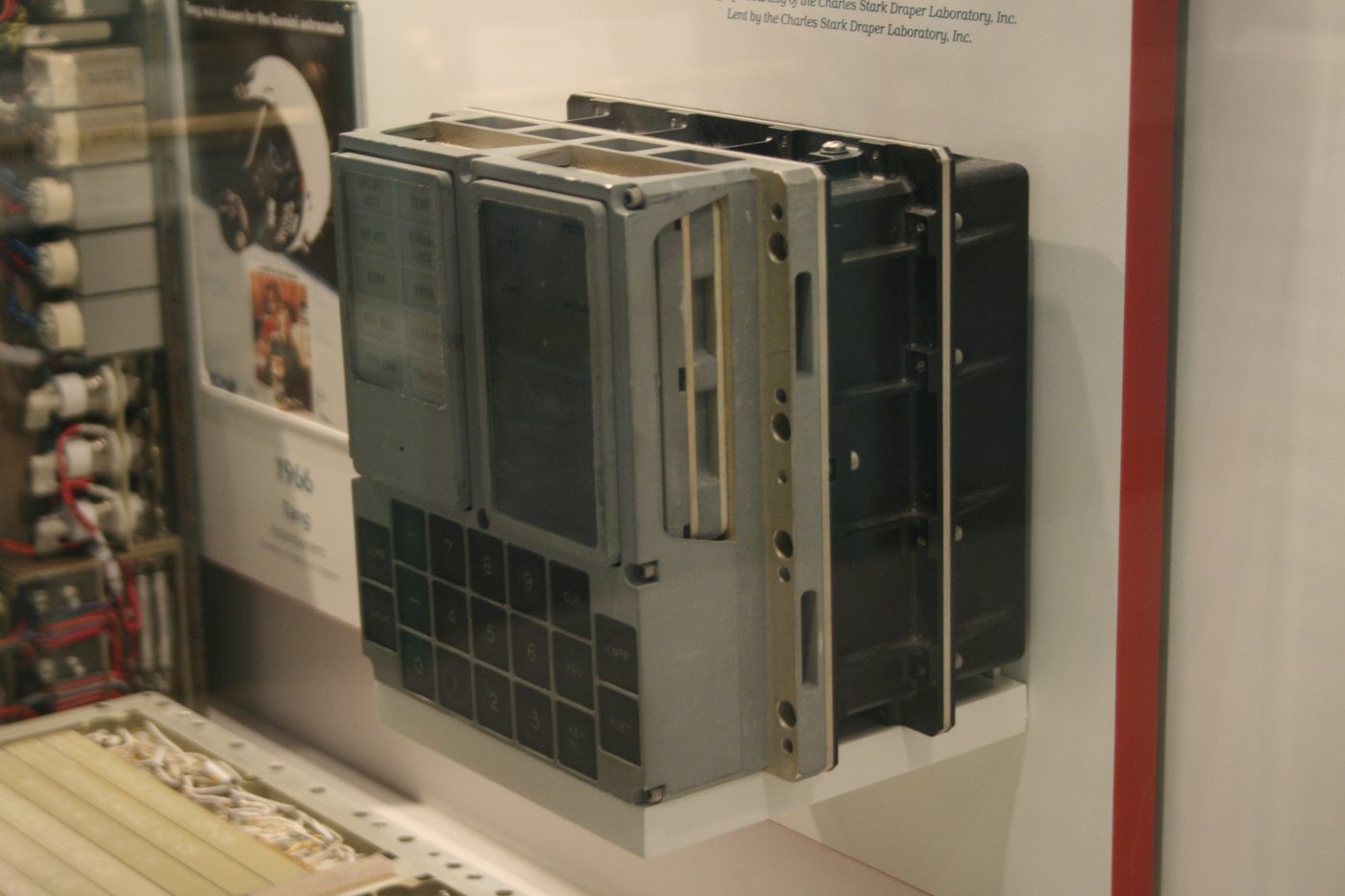
To appreciate the verb-noun idea you have to feel the constraints that produced it. The AGC of the mid-1960s had roughly 36,000 words of fixed (rope) memory and about 2,000 words of erasable memory — a vocabulary of storage so small that every byte was rationed. The display was not a screen in any modern sense. It was three rows of five seven-segment numeric digits, plus a sign, plus two small two-digit windows labeled VERB and NOUN, plus a PROG window showing the running program number. There were ten digit keys (0–9), and six function keys: VERB, NOUN, ENTR (enter), CLR (clear), PRO (proceed), KEY REL (key release), plus the +, −, and RSET keys, depending on how you count. The whole instrument could display numbers and only numbers.
A designer facing that hardware has a brutal question to answer. How do you let a human being command hundreds of distinct operations — align the inertial platform, display velocity, start the landing program, test the lamps, load a star’s coordinates, monitor altitude continuously — using nothing but digits and a couple of soft keys? You cannot spell out “DISPLAY VELOCITY.” You have no letters. You barely have room in memory to store the menus you would need.
The answer the MIT Instrumentation Laboratory arrived at was to treat the interface like a tiny, rigid language. Not English — a constructed pidgin with exactly two parts of speech.
9.3 The Grammar: Verb + Noun
The central idea is almost embarrassingly simple, which is precisely why it works. Every command to the computer is built from two two-digit numbers:
- A VERB — the action you want performed. “Display,” “monitor,” “load,” “test,” “change program.”
- A NOUN — the object or data the action acts upon. “Time,” “velocity and altitude,” “a star’s identifier,” “the landing data.”
The crew keyed them in a fixed order: press VERB, two digits; press NOUN, two digits; press ENTR. The instant ENTR was pressed, the computer executed the sentence. VERB 06 NOUN 36 ENTR — usually written V06 N36 E — means “perform decimal display (verb 06) of the AGC clock time (noun 36).” The machine then lights the three registers with hours, minutes, and seconds.
This is grammar in the literal sense. A verb is conjugated by what noun follows it. The same verb 06 (“display in decimal”) can act on dozens of different nouns and produce completely different readouts; the same noun can be acted on by different verbs — displayed once with V06, monitored continuously with V16, or written to with a load verb. Action and object are orthogonal. You don’t need a separate command for “display velocity” and another for “display time” and another for “display attitude.” You need one display verb and a noun for each kind of data. The combinatorics do the work: a few dozen verbs times a few dozen nouns yields a vocabulary of thousands of meaningful sentences, all expressible on a numeric keypad, all storable in a couple of compact tables in rope memory.
This is why the scheme was brilliant for a machine with a tiny display and few keys. It is compact (two numbers and a key), it is extensible (add a new noun and every existing verb can immediately operate on it), and it is uniform (the crew learns one ritual — verb, noun, enter — and it never changes regardless of what they’re commanding). For a system that had to be memorized, practiced in simulators, and executed correctly under enormous stress, that uniformity was worth more than any cleverness.
9.4 A Working Vocabulary
A few verbs did most of the everyday work. The list below shows representative, verified examples — a flavor of the language rather than the full dictionary, which ran to dozens of verbs and over a hundred nouns.
Table 1 — A Working Vocabulary
| Verb | Meaning |
|---|---|
| V05 | Display octal components of the data |
| V06 | Display decimal data |
| V16 | Monitor (continuously display) decimal data |
| V35 | Test the DSKY lamps (lamp test) |
| V37 | Change major mode — i.e. select a program |
The distinction between V05 and V06 is the distinction between two number worlds. V06 shows you human-friendly decimal — degrees, feet per second, minutes and seconds. V05 shows you the raw octal contents of memory, the form an engineer wants when debugging the machine itself. V16 is the same as V06 except that it doesn’t display once and stop — it keeps refreshing, so a crew member can watch a quantity change in real time. During a rocket burn or a descent, V16 turns a register into a live gauge.
The nouns name the data:
Table 2 — The nouns name the data
| Noun | Meaning (representative) |
|---|---|
| N36 | Time (AGC clock / ground elapsed time) |
| N62 | Velocity, altitude rate, and altitude (powered flight) |
| N68 | Landing-related data during descent (range, time, altitude information) |
And above the verb-noun layer sat the programs — the “P” numbers — which were the computer’s major modes. A program is a larger piece of software that runs a whole phase of the mission; verbs and nouns are how the crew talked to whatever program was running. You selected a program with verb 37.
Table 3 — A Working Vocabulary
| Program | Role |
|---|---|
| P00 | Idle / standby — pronounced “pooh” |
| P52 | IMU realignment (re-orient the inertial platform to the stars) |
| P63 | Powered descent — braking phase |
| P64 | Powered descent — approach phase |
| P66 | Landing — manual / rate-of-descent control |
P00, the idle program, is the one with the famous nickname. Engineers called it “pooh,” as in Winnie-the-Pooh, and “running pooh” or “going to pooh” meant putting the computer into its quiet housekeeping state where it simply kept the clock and tended the inertial platform. You commanded it with the slightly odd-looking V37 E 00 E — verb 37, enter, then the program number 00 where a noun would normally go, enter.
9.5 Two Sequences, Keyed for Real
Consider the two most evocative kinds of sentence in this language — starting a program, and monitoring data — as a crew would actually have keyed them.
Starting the braking phase of the lunar descent. The Lunar Module is in orbit; it’s time to begin powered descent. The commander keys:
V37 E 63 EVerb 37 announces “I want to change the major mode.” The VERB window flashes 37, asking the crew to supply the program number. They key 6, 3, and press ENTR. The computer transitions into P63, the braking program, lights the descent engine on schedule, and begins flying the LM down from orbital speed toward the surface. From that single short sentence cascades the most consequential rocket burn of the mission.
Monitoring the descent. With the descent underway, a crew member wants to watch the critical landing numbers tick by, live. They key:
V16 N68 EVerb 16 (“monitor in decimal”), noun 68 (the landing data set), enter. Now the three green registers continuously refresh with the descent quantities, updating moment to moment as the spacecraft falls toward the Moon. At other points, the crew might similarly have monitored V16 N62 to watch velocity, altitude rate, and altitude change in real time during a burn. The display stops being a readout and becomes an instrument you fly by.
These were not abstractions. Sequences exactly like these — V37 to step through the descent programs, V16 to watch the numbers — are what the crews of the lunar landings keyed during the descents we will follow in Volumes 12 and 13.
9.6 The Interaction Flow: A Conversation in Lights
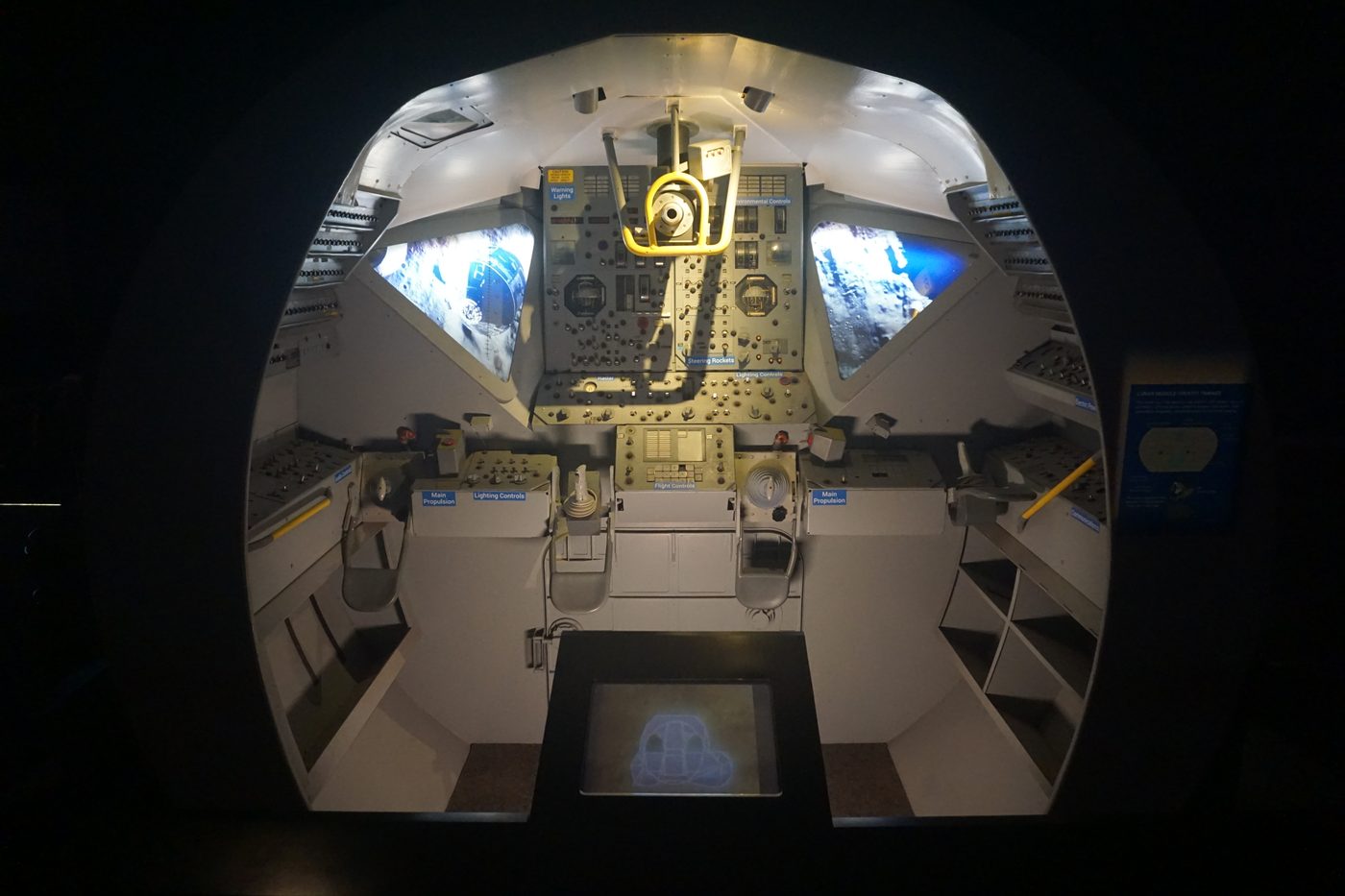
What makes the verb-noun scheme feel less like punching numbers and more like a conversation is that the dialogue ran in both directions. The crew could command the computer, and the computer could turn around and request something from the crew. The mechanism for both was the same small set of lamps and keys.
Flashing verb/noun — the computer asks. When the VERB and NOUN windows flash on and off, it means the computer is waiting for the crew. After V37 E, the verb window flashes 37 to say “give me the program number.” When a program reaches a decision point and needs the crew to confirm or supply data, it flashes a verb-noun pair at them. A steady display is information; a flashing display is a question.
PRO — proceed. When the computer’s flashing request is really an offer — “shall I go ahead with the value I’m proposing?” — the crew answers by pressing PRO (PROCEED). PRO is the affirmative, the “yes, continue” key. In the descent, certain program transitions and certain proposed actions waited on a PRO from the crew before the software would commit.
ENTR — execute. Where PRO means “proceed with what you, the computer, are proposing,” ENTR means “execute the sentence I, the human, have just typed.” ENTR closes a verb-noun command; it also confirms a value the crew has keyed in when loading data.
OPR ERR — operator error. Key an illegal combination — a verb that makes no sense with that noun, a value out of range, a fumbled sequence — and the OPR ERR (operator error) lamp lights. It is the computer’s polite way of saying “I didn’t understand that.” The crew clears it (with the RSET / reset key) and re-keys the command. Crucially, a bad keystroke produced a rejected command and a lit lamp, not a wrong action — a small but vital piece of safety engineering.
KEY REL — key release. Because the same DSKY served both the crew and the running software, the two could collide: a program might need to flash something at the crew while the crew was in the middle of typing. When the computer needs the display back, it lights KEY REL (key release). That lamp is the computer asking the human to “let go” of the keyboard so the program can use it. The crew presses the KEY REL key to hand control back. It is, in effect, a turn-taking protocol — a courteous “may I have the floor?” rendered in a single amber lamp.
Loading data — the human answers. The conversation’s richest mode was data entry. A “load” verb followed by a noun told the computer the crew was about to give it numbers — say, the coordinates of a navigation star for a P52 platform alignment. The computer would flash, the crew would key the digits with the +/− and number keys and press ENTR for each component, and the loaded values would settle into the registers. Verb to ask, noun to name, digits to fill, ENTR to commit: the same grammar, run in reverse.
The lamp test, V35, deserves a closing mention here because it captures the spirit of the whole design. Before trusting your life to a panel of glowing numbers, you want to know that every segment and every warning lamp actually works. V35 lights everything at once — all eights in the registers, all the status lamps — so the crew can confirm at a glance that nothing has burned out. One short verb; total reassurance.
9.7 Origin: A Stopgap That Refused to Die
The most surprising thing about the verb-noun language is that nobody set out to design it as the flight interface. It began life as a demo.
In the early 1960s, before anyone at the MIT Instrumentation Laboratory had written formal software requirements for how a crew would talk to the guidance computer, the lab wanted to stand up a demonstration unit — something to show that a digital guidance computer could be operated at all. A small group of coders, prominently Ramon Alonso, threw together a demonstration program and, to drive it, invented the verb-noun convention essentially on the spot. It was a quick, pragmatic way to let a person exercise the machine. No one imagined it would survive into the actual flight software; it was scaffolding, meant to be replaced once the “real” interface was designed.
But the real interface never displaced it. As the program matured, it became clear that there simply were no better alternatives that fit inside the AGC’s punishing constraints. The verb-noun scheme was compact, it was learnable, it was extensible, and it was already working. So the stopgap flew — on every crewed Apollo mission, on every Command Module and every Lunar Module, all the way to the Moon.
There is a lovely detail in Alonso’s own background that may have shaped the choice. Born in Argentina and a native Spanish speaker, the son of a linguist, Alonso had learned English as a second language. Thinking of machine commands as little sentences — an action word and a thing it acts on — came naturally to someone who had consciously learned the architecture of a foreign grammar. The interface that flew to the Moon carries, faintly, the imprint of a linguist’s household.
The astronauts’ reactions varied, as you would expect of test pilots handed a numeric ritual to memorize. Many came to like it; with enough simulator hours the verb-noun dance became second nature, and at least one crew member likened working the keys to playing the piano — a learned fluency where the fingers know the sequence before the mind has spelled it out. Others found the constant keying tedious, a lot of two-digit bookkeeping between a pilot and his spacecraft. But tedious or elegant, it worked, and it worked under the worst pressure under which human beings have ever operated a computer. That is the verdict that mattered.

9.8 The Cultural Afterlife
Half a century on, “verb-noun” has become an icon of computing history — shorthand for the moment when human beings first had to negotiate, in real time, with a digital computer that was flying them somewhere they could not survive a mistake. The DSKY’s green digits and its VERB/NOUN legends are instantly recognizable to people who could not tell you a single thing about rope memory or the AGC’s instruction set. Replica DSKYs are built by hobbyists; the interface appears in documentaries, museum exhibits, and even a wristwatch styled after the panel. The phrase itself has escaped into the wider language of design as a touchstone: a reminder that a good interface is not the one with the most features or the prettiest screen, but the one whose grammar fits its constraints so well that ordinary, frightened, brilliant humans can drive it flawlessly when everything is on the line.
It is a strange immortality for something its creators called a stopgap. The verb-noun language was supposed to be thrown away. Instead it became the way the human race talked to the first computer it trusted with its life — and, in doing so, it earned a permanent place in the history of how people and machines learn to understand each other.
Volume 8 gave you the panel these words ran across; Volumes 12 and 13 will show you the words in action, second by second, as Eagle and the others fell toward the Sea of Tranquility and the crews kept up their quiet, numeric conversation with a computer the size of a briefcase — verb, noun, enter — all the way down.
Next — Volume 10: The Software and the Executive.
Comments (0)