DSKY · Volume 4
DSKY — Volume 4 — The Integrated-Circuit Gamble
How a moon mission bet its crews on a three-year-old invention
4.1 About This Volume
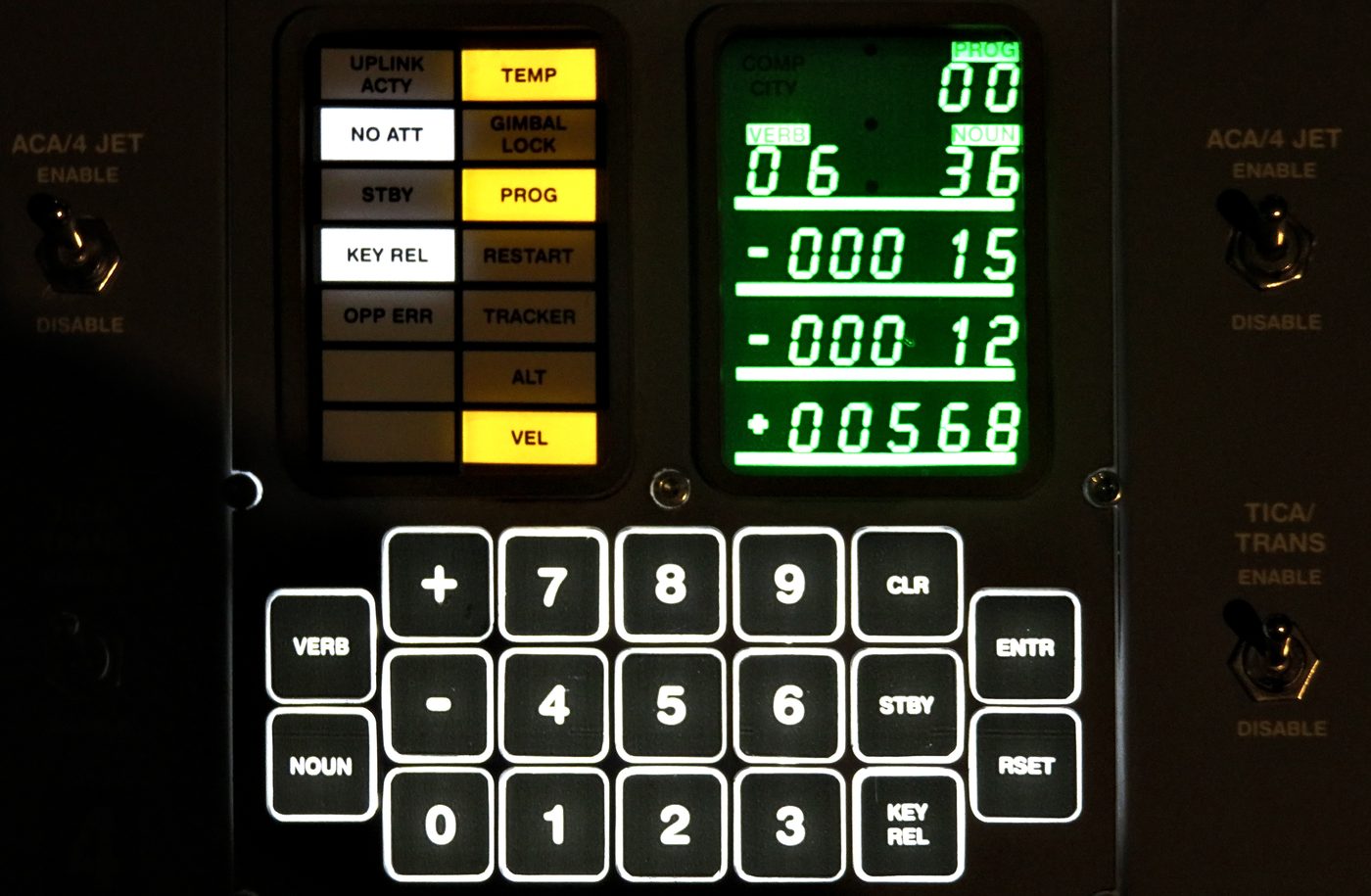
The Apollo Guidance Computer is remembered, fairly, as a marvel of compression: a 70-pound box that drew about 55 watts, ran at 2.048 MHz on a 16-bit word, and flew human beings to the surface of another world and back. But the most consequential decision behind it was not how small it was. It was what it was made of. In 1962, the MIT Instrumentation Laboratory chose to build the AGC’s entire logic — every gate that added, compared, branched, and counted — out of the integrated circuit, a component that had been invented only three or four years earlier and that almost no one yet trusted with anything, let alone with astronauts.
This volume is about that gamble: the state of the chip in 1961–62, the decision championed by Eldon Hall to build the computer from essentially a single, dirt-simple kind of chip, the staggering scale of Apollo’s appetite for those chips, and the reliability regime that made the bet survivable. It is also, carefully, about a famous claim — that Apollo “created Silicon Valley” — which is half true and half myth, and worth getting right. Where this volume gestures at the differences between the two AGC generations, the full story of Block I versus Block II waits in Volume 7; the machine’s architecture is the subject of Volume 6.
4.2 A Component Almost Nobody Trusted
To feel the weight of the decision, you have to remember how new the integrated circuit was. The idea of fabricating multiple electronic components together on a single piece of semiconductor was demonstrated by Jack Kilby at Texas Instruments in 1958, and given its practical, manufacturable form — the planar, monolithic silicon chip with components wired together by deposited metal — by Robert Noyce at Fairchild Semiconductor in 1959. In 1961 and 1962, the IC was barely out of the laboratory. It was made by a handful of firms in tiny quantities, it was wildly expensive, and its long-term reliability was unknown because there simply was not enough operating history to know it.

Conventional flight electronics of the era did not use chips at all. They used discrete components: individual transistors, resistors, and diodes, soldered together — often in “core-transistor” logic that paired tiny magnetic cores with transistors to make rugged, radiation-tolerant switching elements. That was the safe, proven path, and the Instrumentation Lab knew it well; the lab’s earliest AGC design studies, around 1960–61, assumed core-transistor logic. A guidance computer for a manned spacecraft was about as conservative an application as one could imagine. Lives depended on it, the schedule was brutal, and the politically rational move was to use parts with a track record.
The problem was that the conservative path could not deliver the machine Apollo needed. A core-transistor AGC would have been larger, heavier, hungrier for power, and slower than the mission could tolerate. The lunar mission’s mass and volume budgets were merciless, and every watt the computer drew was a watt the spacecraft had to carry as fuel and batteries. The integrated circuit offered a way out — if it could be trusted. That “if” is the whole story of this volume.
4.3 The Decision: One Gate to Build a Computer
In 1962, the Instrumentation Lab made the call. Eldon C. Hall, who led the AGC’s hardware design under the lab’s director Charles Stark Draper, championed building the computer’s logic entirely from integrated circuits. It was, by any reasonable contemporary standard, a reckless choice — and it was made deliberately, with eyes open, because Hall judged that the alternatives were worse and that the chip’s disadvantages were the kind that disciplined engineering could retire.
What made the gamble tractable was a second decision, just as radical as the first: build the whole machine from essentially one type of chip. Not a catalogue of specialized parts, but a single, almost trivially simple logic element, repeated thousands of times.
The Block I AGC used a Fairchild “Micrologic” device containing a single three-input NOR gate — one gate per package. Block II, the version that actually flew with crews, used a package containing two three-input NOR gates: the Fairchild dual NOR gate, designated the μL9915 (descended from the earlier μL900-series Micrologic part). Both were built in resistor-transistor logic, or RTL, and packaged in a flat metal-and-ceramic “flat-pack.” A NOR gate — “not-or” — is the plainest useful thing in digital logic, and it has a remarkable property: it is functionally complete. With nothing but NOR gates you can build every other logic function — AND, OR, NOT, flip-flops, adders, the entire computer. The AGC is, quite literally, a machine made of one idea repeated.
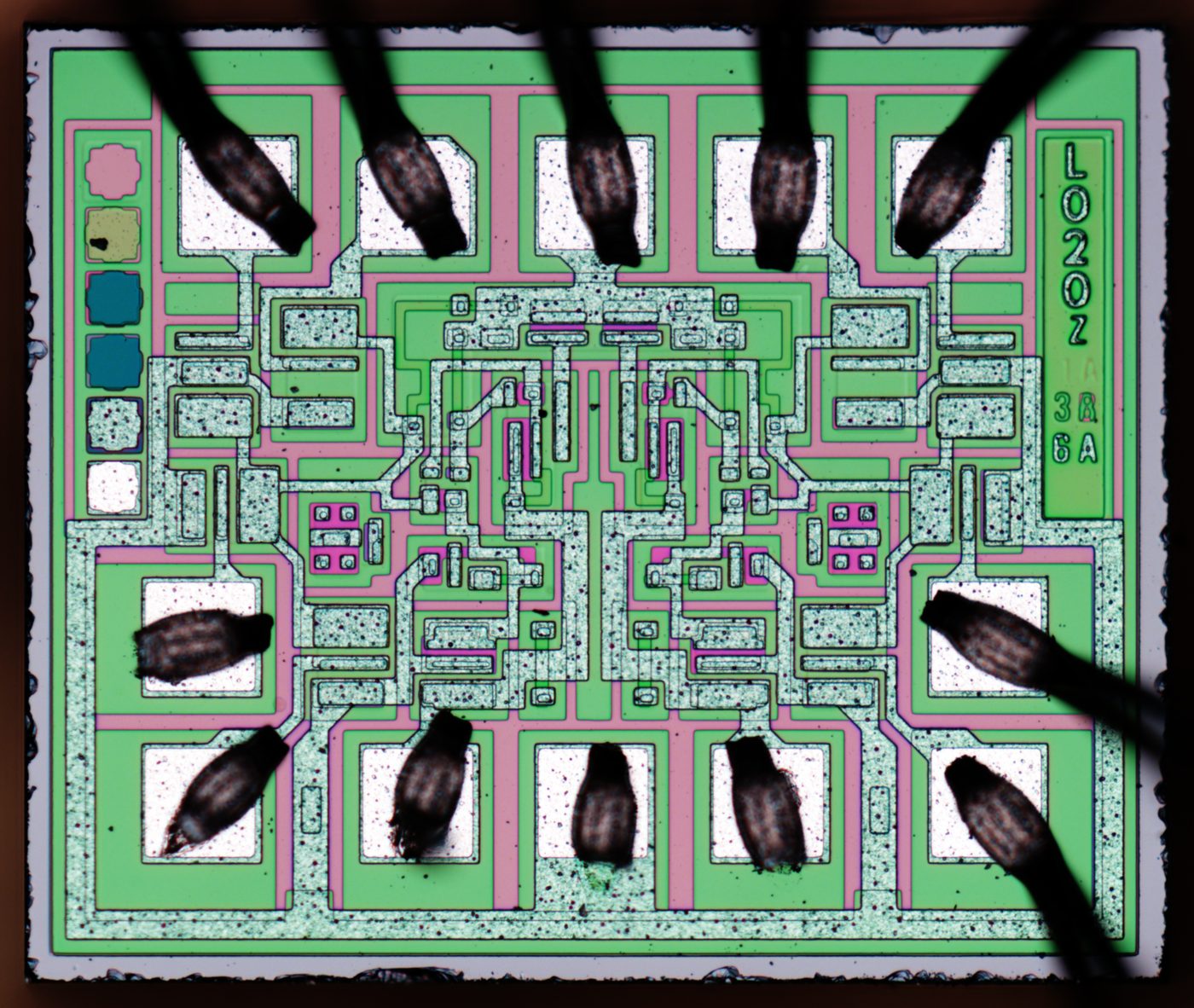
Why reduce a flight computer to a single building block? Because uniformity is a force multiplier for every hard problem the program faced.
Design. When every logic module is assembled from copies of one gate, the design rules collapse to a single, well-characterized cell. The engineers had to understand the timing, fan-out, noise margin, and failure behavior of exactly one circuit, and then they could compose it without surprises. The schematics became repetitive in the best way; the same patterns recurred across the machine.
Testing and qualification. This is the decisive advantage. Qualifying a part for human spaceflight — proving it will survive vibration, vacuum, thermal cycling, and years of storage without drifting or dying — is enormously expensive, and the cost is per part type, not per part. With one gate, the lab could pour essentially its entire parts-qualification budget into characterizing a single device to a depth no one had ever attempted. Every dollar spent screening that one chip improved the reliability of the entire computer. Had the AGC used dozens of part types, the qualification effort would have been spread thin and shallow.
Supply and production. A single high-volume part is easier to source, easier to inspect on receipt, and easier to drive down a learning curve. Ordering one chip by the tens of thousands gave the lab and its suppliers a clean, repeatable manufacturing target — and, as we will see, it gave the chip industry an order of a size it had never seen.
There were costs to the choice. Building everything from NOR gates is not the most efficient use of silicon; a richer logic family would have done the same work with fewer chips. The AGC paid for its uniformity in gate count. But in 1962, with reliability as the overriding constraint and the chip itself an unproven quantity, simplicity bought safety, and safety was the only currency that mattered.
4.4 The Counts
The numbers are worth stating plainly, because they are the physical fingerprint of the design philosophy.
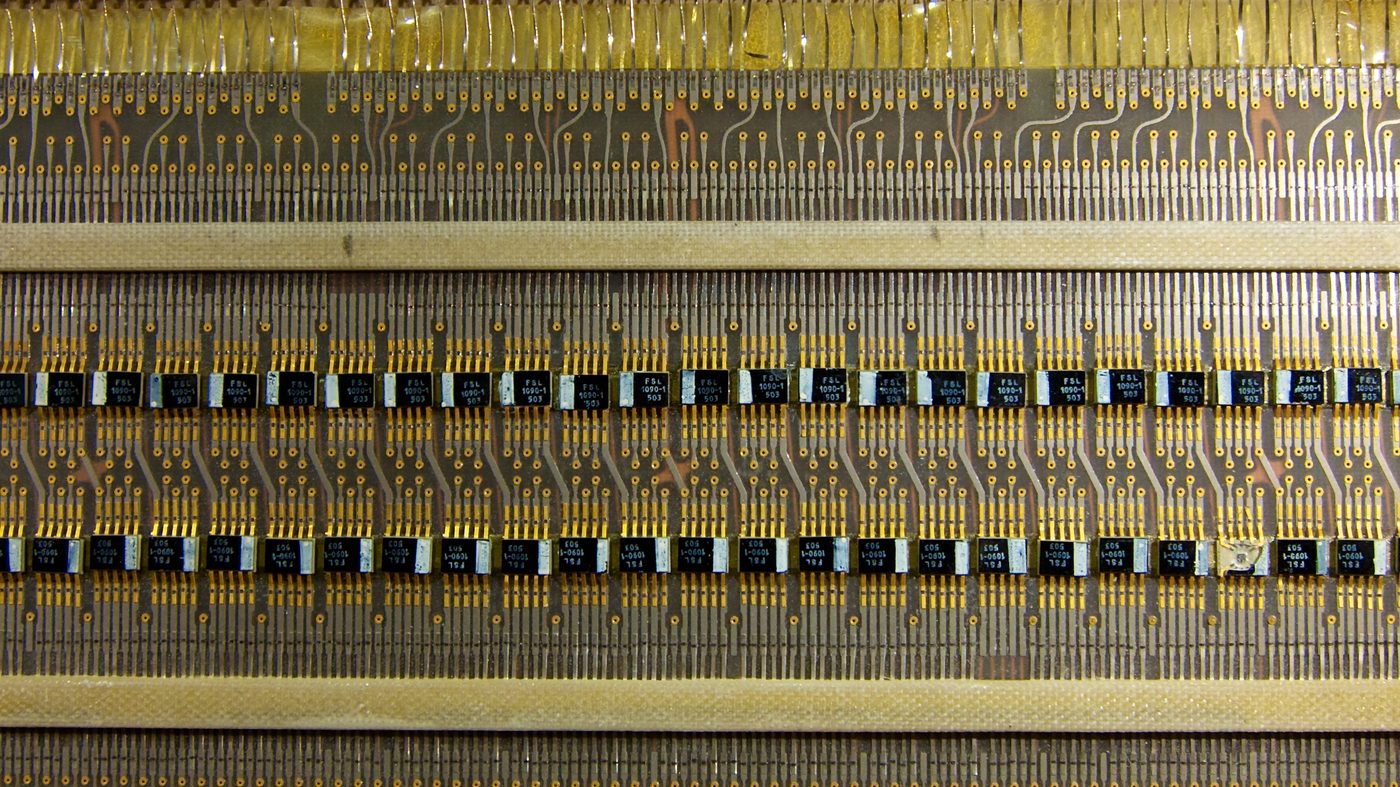
The Block I AGC contained roughly 4,100 integrated circuits, each holding a single three-input NOR gate. The Block II AGC — the production machine of the crewed missions — contained roughly 2,800 integrated circuits, each holding two three-input NOR gates. (Block II’s logic was overwhelmingly the dual NOR gate, with much smaller numbers of related parts such as sense amplifiers and expanders serving the memory and interface circuits.)
Notice what happened between the generations. The gate content of the machine grew, but the chip count fell, because each Block II package now did the work of two Block I packages. Fewer packages meant fewer solder joints, fewer interconnections, less weight, and — crucially — fewer individual things that could fail. Putting two gates in a package was, in miniature, the same move the whole industry was about to make over and over for the next sixty years: integrate more function per chip, and reliability and density improve together. The AGC caught that wave at its very beginning.
4.5 Apollo’s Appetite and the Industry It Helped Forge
Here is where the AGC stops being merely a clever computer and becomes a force in economic history.
In the early 1960s, the integrated circuit had two great customers, and both were on government missions where size, weight, and reliability mattered more than price: the Apollo program and the U.S. Air Force’s Minuteman intercontinental ballistic missile — specifically the Minuteman II guidance system. Together, these two programs purchased almost the entire output of the young IC industry from roughly 1960 through 1963. They were not just early adopters; for a crucial window they were the market.
The frequently cited figure is striking, and it holds up: by 1963, the Apollo program alone was consuming on the order of 60 percent of U.S. integrated-circuit production. (As with most figures from a fast-moving young industry, the exact share varies by source and by exactly what is counted, so “roughly 60 percent” is the honest way to put it — but the order of magnitude is well attested.) Apollo and Minuteman played complementary parts: Apollo, with its demand for the highest-reliability logic, led and motivated the technology, while Minuteman, ramping toward mass deployment, forced it into mass production.
The effect on price was dramatic. An integrated circuit that cost on the order of $1,000 apiece around 1960 had fallen to roughly $25 by 1963, in the dollars of the day. That collapse was not a gift of nature; it was bought by volume. Guaranteed orders of tens of thousands of identical chips let manufacturers invest in yield, refine their processes, and slide down the learning curve — and once the price had fallen that far, other industries could suddenly find applications for the IC, and civilian adoption took off. The military and space programs paid the steep early prices that funded the very improvements that made chips cheap enough for everyone else.
This is the kernel of truth inside the popular claim that “Apollo created Silicon Valley.” It deserves to be stated accurately, because the overstatement is easy and tempting. Apollo did not invent the integrated circuit — Kilby and Noyce did, before NASA had a manned lunar program. Apollo did not single-handedly create the semiconductor industry; Fairchild, Texas Instruments, and others were already in business, and Minuteman was an equally vital early customer. What Apollo did do was act as a pivotal early customer and a reliability proving-ground at the precise moment the technology needed both. By guaranteeing a market before the commercial world was ready, by demanding volumes that drove prices down, and above all by imposing a quality and reliability discipline that the industry had never before been forced to meet, Apollo helped pull the integrated circuit from laboratory curiosity to industrial product. That is a large and genuine contribution — neither the whole story nor a small one.
4.6 Reliability: When a Single Gate Can Kill the Crew
Everything about the AGC’s parts program flowed from one unforgiving fact: in a manned spacecraft, the failure of a single gate, at the wrong moment, could kill the crew. There is no margin in that sentence. A computer with thousands of components, any one of which could be fatal, is only as trustworthy as its least reliable part — and the part in question was an unproven three-year-old invention.
The Instrumentation Lab’s answer was a screening and qualification regime of extraordinary intensity, and the single-gate strategy is what made that intensity affordable. Because there was essentially one chip to qualify, the lab and its manufacturing partner, Raytheon, could subject that chip to a depth of testing that would have been impossible across a diverse parts list.
The discipline ran the whole length of the supply chain. Manufacturing lines were tightly controlled and monitored, so that the chips arriving were made the same way every time. Incoming devices were screened individually, not sampled — every chip, not a representative few. Parts were “burned in,” run under electrical and thermal stress to provoke the weak ones into failing in the lab rather than in flight, exploiting the fact that components that survive an initial stress period tend to be the ones that last. They were cycled through temperature extremes, shaken to simulate launch vibration, and tested in vacuum. Failed parts were not merely discarded; they were analyzed to understand why they failed, and that knowledge fed back into the process so the same failure mode would not recur. The result was a body of reliability data on a single integrated circuit that was, for its time, without equal — and a measured field reliability for the AGC’s logic that vindicated the gamble.
This is the often-overlooked second half of Apollo’s gift to the chip industry. The price collapse is the famous part. But the reliability methods — the burn-in, the screening, the failure analysis, the statistical process control, the insistence that a manufacturer prove and reprove that its product was uniform and durable — were a discipline the semiconductor business absorbed and carried forward. The standards the space and missile programs demanded raised the floor for everyone. A generation later, when integrated circuits would be trusted to run anti-lock brakes and pacemakers and the avionics of every airliner, they did so on a foundation of reliability practice that programs like Apollo had forced into existence when the stakes were a crew on the way to the Moon.
4.7 Why the Gamble Paid
It is tempting, with hindsight, to think the choice obvious. It was not. In 1962 a sober risk assessment of the integrated circuit would have counseled waiting — letting the part mature, letting someone else absorb the early failures, choosing the proven core-transistor path for a mission where the cost of being wrong was measured in lives. The Instrumentation Lab went the other way, and it went there for reasons that survive scrutiny: the chip was the only route to a computer light enough, cool enough, and fast enough to fly the mission, and its single great weakness — unproven reliability — was precisely the kind of weakness that could be retired by concentrating the entire engineering effort on a single, simple, exhaustively understood gate.
That is the elegance of the integrated-circuit gamble. The decision to use chips and the decision to use one kind of chip were not two bets but one. Uniformity is what made the unproven provable. By refusing variety, the AGC’s designers turned a frightening question — can we trust this new component? — into a tractable one: can we make this single gate reliable enough? The answer, bought with money, volume, and obsessive testing, was yes. And in answering it for themselves, the people who built the Apollo computer helped answer it for the world.
The two AGC generations that carried this philosophy — the single-gate Block I and the dual-gate Block II — differed in more than chip count, and their story, along with the machine they composed, is where we turn next.
Next — Volume 5: Core Rope Memory — Software You Could Hold.
Comments (0)