DSKY · Volume 2
DSKY — Volume 2 — Why Put a Computer in the Spacecraft?
The autonomy decision, the quarter-million-mile navigation problem, and the August 1961 contract that handed the Moon to a university lab
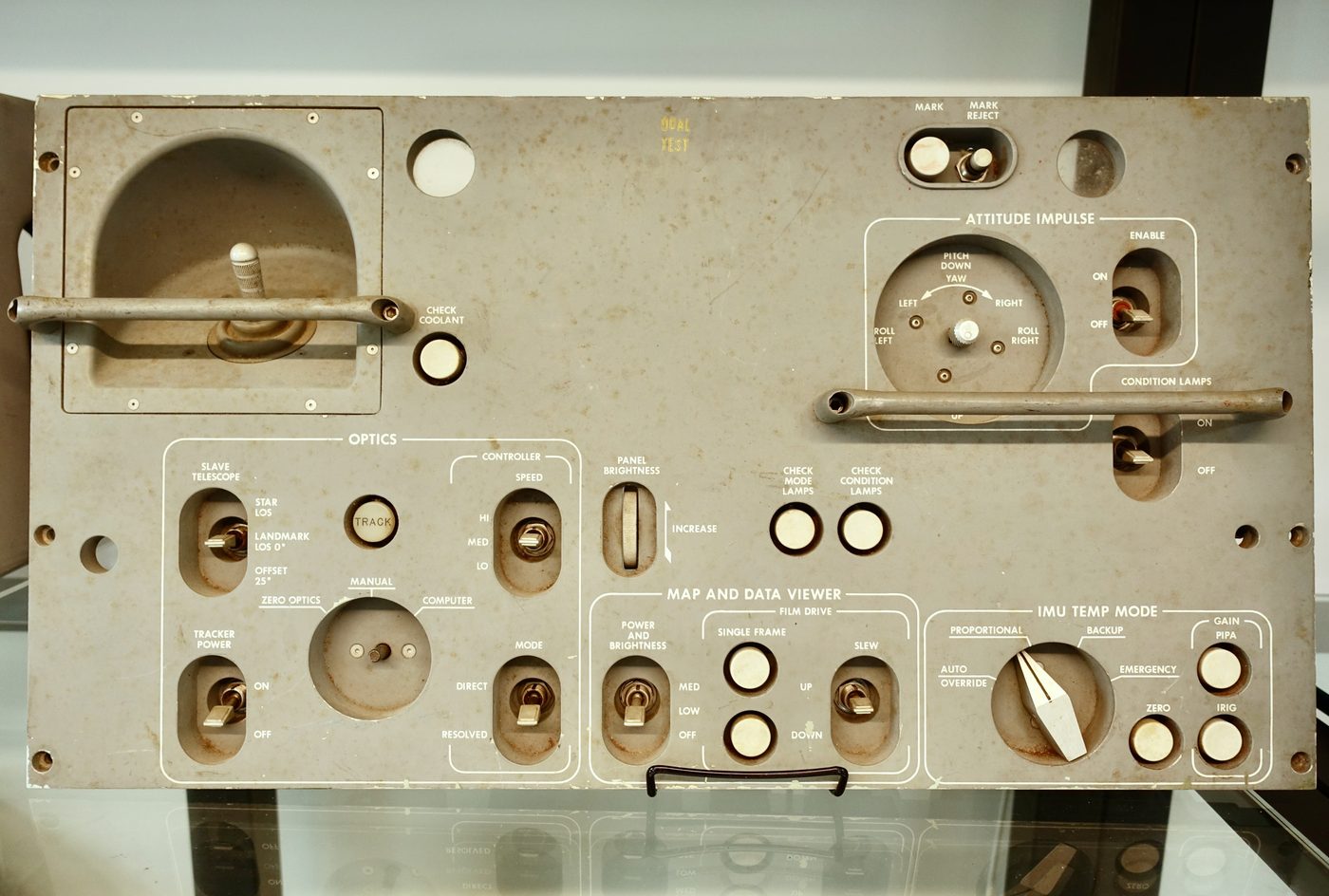
2.1 About This Volume
Volume 1 introduced the machine — a seventy-pound box, the size of two stacked briefcases, that navigated human beings to the Moon and back. This volume asks the question that comes logically before any of the engineering: why was there a computer aboard the spacecraft at all? It was not an obvious choice. In 1961 a digital computer was a room full of cabinets, tended by specialists, and the idea of bolting one into a cramped capsule and trusting astronauts’ lives to it struck many sober people as reckless. That it happened anyway — and happened first, before almost any other piece of Apollo hardware was under contract — is the subject of these pages.
The story has three threads, and they braid together. The first is a navigation problem of genuine difficulty: hitting a moving Moon a quarter of a million miles away, and coming home. The second is a decision about autonomy — whether the spacecraft should be able to find its own way without help from the ground, a decision shaped as much by Cold War anxiety as by orbital mechanics. The third is a contract: the guidance-and-navigation award NASA made in August 1961 to the MIT Instrumentation Laboratory, widely remembered as the first major hardware contract of the entire Apollo program, and remarkable for going not to an aircraft company but to a university research lab run by a man who promptly volunteered to fly the mission himself.
This volume sets up the two that follow — the Lab itself in Volume 3, and the audacious bet on integrated circuits in Volume 4.
2.2 The Quarter-Million-Mile Problem
Begin with the geometry, because the geometry is what forced everything else.
The Moon orbits the Earth at an average distance of roughly 384,000 kilometers — about a quarter of a million miles — and it does not sit still waiting to be reached. It sweeps along its orbit at just over a kilometer per second. A spacecraft leaving low Earth orbit toward it is itself moving at nearly eleven kilometers per second at the start of the trip. Both bodies are falling continuously: the spacecraft around the Earth, the Earth and Moon around their common center, the whole system around the Sun. There is no straight line to draw and no stationary destination to aim at. To go from here to there, a navigator must aim not at where the Moon is but at where it will be some three days hence, and must keep refining that aim the entire way.
Worse, the tolerances are brutal. To swing around the Moon on a free-return trajectory — the path that loops behind it and lets gravity sling the ship back toward Earth — the approach corridor is only a few kilometers wide at a target a quarter-million miles off. A small error in velocity at departure, multiplied by three days of coasting, becomes an enormous error on arrival. And the corrections are not gentle nudges you can make at leisure; they are rocket burns of a precise magnitude, in a precise direction, fired at a precise instant. Burn a fraction of a second too long and the trajectory is wrong. Point a degree off and the trajectory is wrong. Coming home, the margin is, if anything, narrower still: the returning capsule must thread an atmospheric-entry corridor only a couple of degrees wide. Too steep and the deceleration crushes the crew; too shallow and the spacecraft skips off the atmosphere like a stone off a pond and is lost.
To do any of this you need two things continuously and accurately: where you are (position and velocity, in some agreed frame of reference) and which way you are pointed (attitude). From those you compute what burn to make, and when. This is the entire job of a guidance-and-navigation system, and it is why a spacecraft going to the Moon needs one of unprecedented quality. The question Apollo had to answer in 1961 was not whether to navigate — that was never in doubt — but where the navigating would be done: on the ground, in the spacecraft, or both.
2.3 The Case for Doing It Onboard
A natural instinct, then and now, is to put the computing where it is easy to maintain: on the ground. The Earth-based tracking stations of what became the Manned Space Flight Network could measure a spacecraft’s range and velocity with great precision by bouncing radio signals off it and timing the echoes. Mission Control could run the trajectory calculations on big mainframes and simply tell the crew what to do. Why carry a computer to the Moon when you can leave it in Houston?
There were several answers, and in 1961 they were persuasive enough to settle the matter in favor of onboard capability.
The first answer was radio light-time. Radio waves travel at the speed of light, which is fast but not infinite. The Moon is far enough away that a signal takes roughly 1.3 seconds to reach it one way — about 2.6 seconds for a question to go up and an answer to come back, before any human or computer at either end has done a moment’s thinking. For coasting flight, a few seconds of lag is tolerable. For the critical, dynamic phases — and above all the powered descent to the lunar surface, where the situation changes from instant to instant and a burn must be adjusted in real time — a multi-second round trip to a controller on another world is not a control loop you can fly a landing through. The decisions had to be made where the action was.
The second answer was Cold War distrust of dependence. Apollo was conceived in the most adversarial decade of the twentieth century, and its engineers and sponsors were steeped in military thinking. A system that needed a continuous radio link to a ground station was a system with a single point of failure — and, in the strategic imagination of 1961, a point an adversary might attack. What if the link were jammed? What if it were denied? A spacecraft that could not find its own way home if the ground went silent was, by this logic, an unacceptable spacecraft. Inertial guidance — self-contained, emitting nothing, receiving nothing, immune to jamming because it listens to no one — was the natural answer of men who had built guidance systems for ballistic missiles precisely so those missiles would not depend on anyone telling them where to go. The same instinct that made inertial guidance attractive for a Polaris missile made it attractive for a Moonship.
The third answer was redundancy as a plain engineering virtue. Even setting espionage aside, ground stations fail, antennas point wrong, and radio links drop. A spacecraft three days from home, carrying a crew, ought to be able to navigate itself as a matter of basic safety, whatever Mission Control could or could not do at a given moment. Belt and suspenders is not paranoia when the alternative is leaving astronauts stranded.
So the early Apollo concept leaned hard toward autonomy. The Command Module was envisioned as a ship that could navigate largely on its own — a human navigator taking sightings on the stars with an optical instrument, an inertial platform holding a steady reference, and an onboard computer turning sightings and accelerations into a position and a plan. Ground tracking was conceived, at the outset, as the backup. As the program matured the balance shifted: ground tracking proved so accurate, and the onboard star-sighting so laborious, that in practice the Earth-based network did most of the translunar navigation, with the crew’s sightings serving as the check. But — and this is the point that mattered — the onboard capability was built, qualified, and carried on every flight. It was there to be used, and on the journeys where it counted most, it was used. The autonomy was real even when, fortunately, it did not have to carry the whole load.
2.4 The Contract That Started Everything
For all of this to be more than a memo, somebody had to be hired to build it. And here the Apollo story takes a turn that still surprises people.
President Kennedy delivered his “land a man on the Moon” challenge to a joint session of Congress on 25 May 1961. NASA, with no Moon rocket, no lunar spacecraft, and no agreed plan for getting to the Moon, began letting contracts. The very first major hardware contract of the entire Apollo program — before the spacecraft that would carry it, before the rocket that would launch it, before most of the program existed on paper — was for the guidance and navigation system. NASA awarded it in August 1961 (the formal go-ahead came on the ninth) to the Instrumentation Laboratory of the Massachusetts Institute of Technology. The decision was made roughly eleven weeks after Kennedy spoke. NASA knew that whatever else the Moon program would need, it would need a way to find the Moon, and it moved on that need first.
What makes the award remarkable is not only its priority but its recipient. This was not a contract to North American or Douglas or Grumman or any of the great airframe houses that would build the rest of Apollo. It went to a university laboratory — an academic research shop, not a production company. NASA was betting that the people who best understood how to navigate to the Moon were the people who had spent two decades inventing the art of inertial guidance, and that those people were at MIT. It was an unusual bet, and a revealing one: at the very outset of the Moon program, the agency reached past the aerospace industry to a campus lab.
The Lab itself was, at first, almost disarmingly unready for the scale of what it had won. “We had a contract,” the engineer Richard Battin later recalled, “but … we had no idea how we were going to do this job, other than to try to model it after our Mars probe.” They had, in other words, a mandate and a deadline and a great deal of relevant expertise — and a blank sheet of paper where the Moonship’s brain would go. Filling that sheet is the work the rest of this series describes.
2.5 Doc Draper and the Offer to Fly
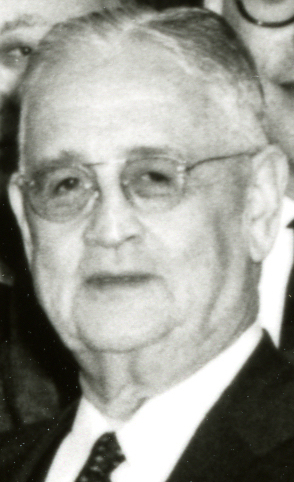
The Instrumentation Laboratory was the creation, and very nearly the shadow, of one man: Charles Stark Draper — “Doc” to everyone who worked for him. Draper had joined MIT as a student in the 1920s and essentially never left, accumulating degrees and then building, over decades, the field of inertial guidance more or less from scratch. The idea is deceptively simple and fiendishly hard to realize: if you can measure every acceleration a vehicle experiences, with sufficiently sensitive gyroscopes and accelerometers mounted on a platform that holds steady against the vehicle’s tumbling, then you can integrate those measurements over time to know your velocity, and integrate again to know your position — all without looking outside, without radio, without any reference but the unchanging laws of motion. Draper’s lab had made this real in hardware: in aircraft bombsights, in the SPIRE system that guided an airplane coast-to-coast across the United States in 1953 with no human touching the controls, and in the guidance package for the Navy’s Polaris submarine-launched missile. By 1961 there was no group on Earth with a stronger claim to know how to make a machine find its own way.
Draper believed in his life’s work with an intensity that has become one of Apollo’s favorite anecdotes — and unlike many such stories, this one is documented. He was so certain that inertial guidance could take men to the Moon that, late in 1961, he wrote to NASA’s Associate Administrator, Robert Seamans (himself a former student), and volunteered to fly the mission as an astronaut. He was fifty-nine going on sixty. He knew the age was a problem and said so plainly: “I realize that my age of 60 years is a negative factor in considering my request, but … I will gladly undergo any physical examinations and tests that may be prescribed and will take any courses of training that may be recommended.” And then the line that captures the whole spirit of the thing: “If I am willing to hang my life on our equipment, the whole project will surely have the strongest possible motivation.”
He did not get the seat, of course. But the gesture was not mere theater. It was Draper staking his personal credibility — his body, he was offering — on the proposition that the machines his Laboratory was about to build would work. That confidence, transmitted to a few hundred young engineers who suddenly held the Moon in their hands, was worth more than any memo. Volume 3 is about those engineers and the Laboratory they worked in; here it is enough to say that the man at the top of it would, in writing, have bet his life.
2.6 The Shape of the System
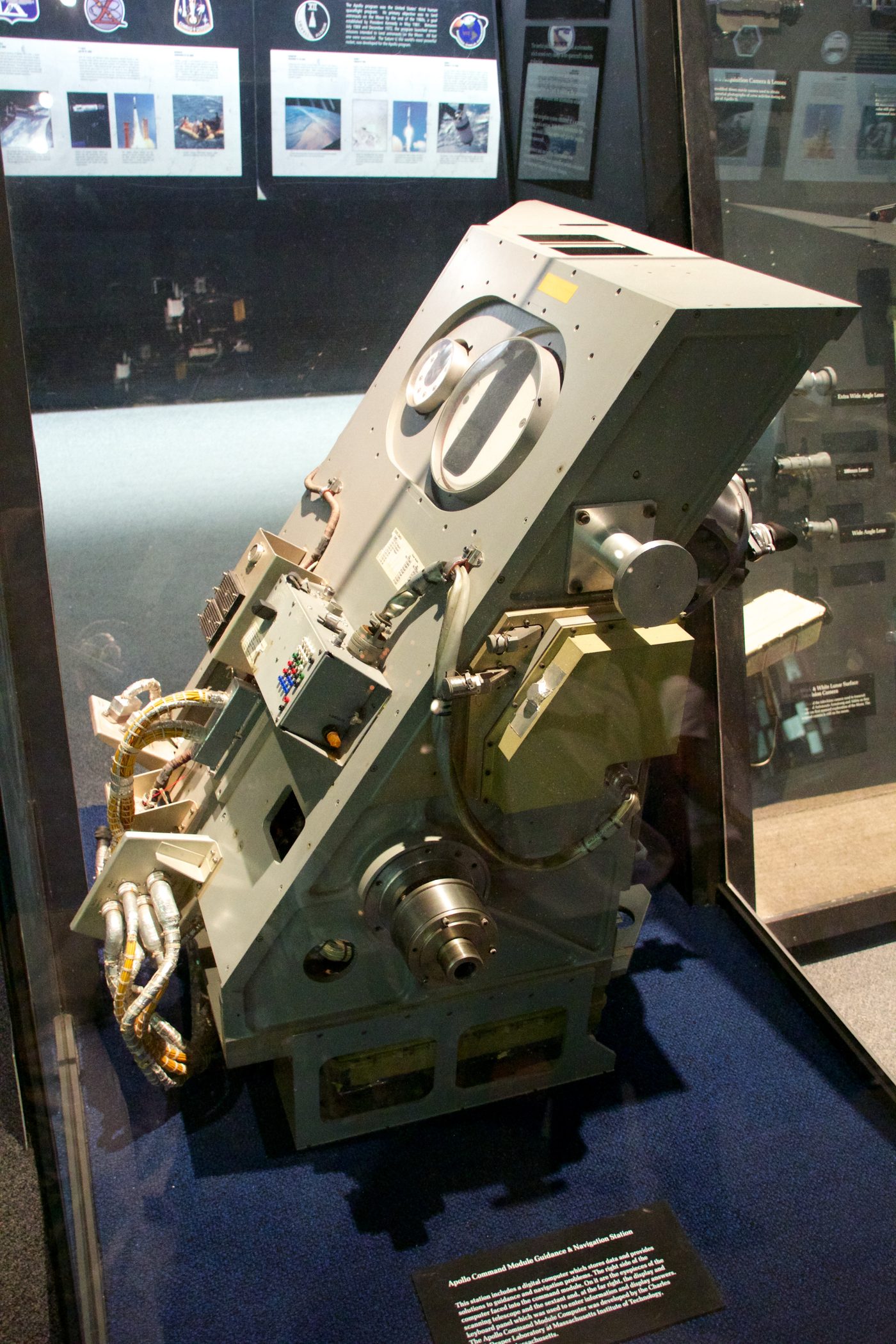
What, concretely, did the Instrumentation Laboratory contract to build? The Apollo Guidance and Navigation system — later, with the control function folded in, the Primary Guidance, Navigation, and Control System, or PGNCS, pronounced “pings” — had three principal parts, and understanding how they fit together is the foundation for everything that follows.
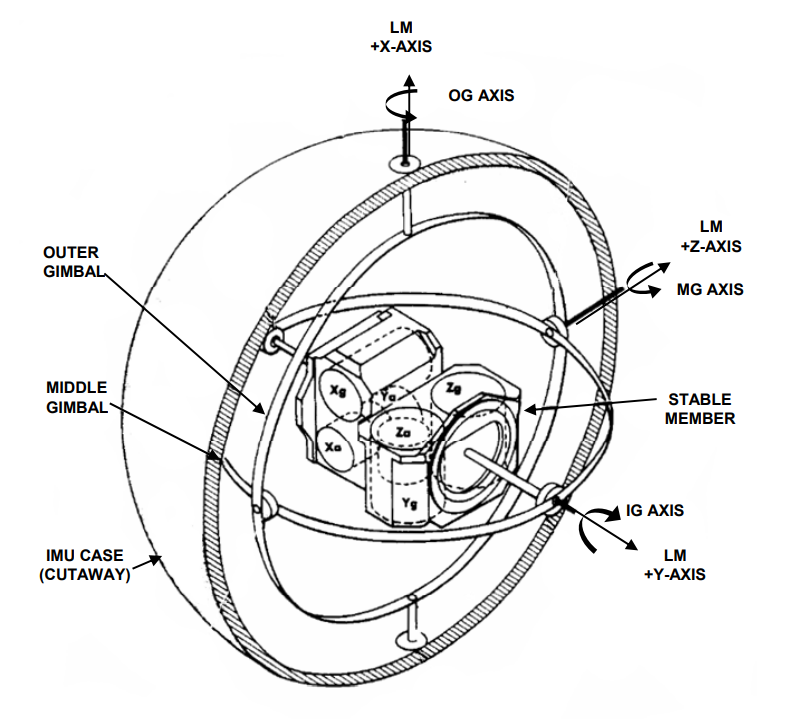
The first part was the Inertial Measurement Unit, the IMU: the inertial heart of the system. Inside it, a small platform was held by a nest of gimbals so that it could keep a fixed orientation in space no matter how the spacecraft pitched, rolled, or yawed around it — a “stable member” that pointed the same way always, a steady island in a tumbling sea. Mounted on that platform were gyroscopes, which sensed any attempt to twist it and drove motors to cancel the twist, and accelerometers, which measured every push the spacecraft felt along three axes. From the accelerometers’ readings, integrated over time, the system knew the spacecraft’s velocity and position; from the platform’s known orientation, it knew which way was which. The IMU was, in effect, the spacecraft’s inner ear — its sense of motion and balance, working in the dark.
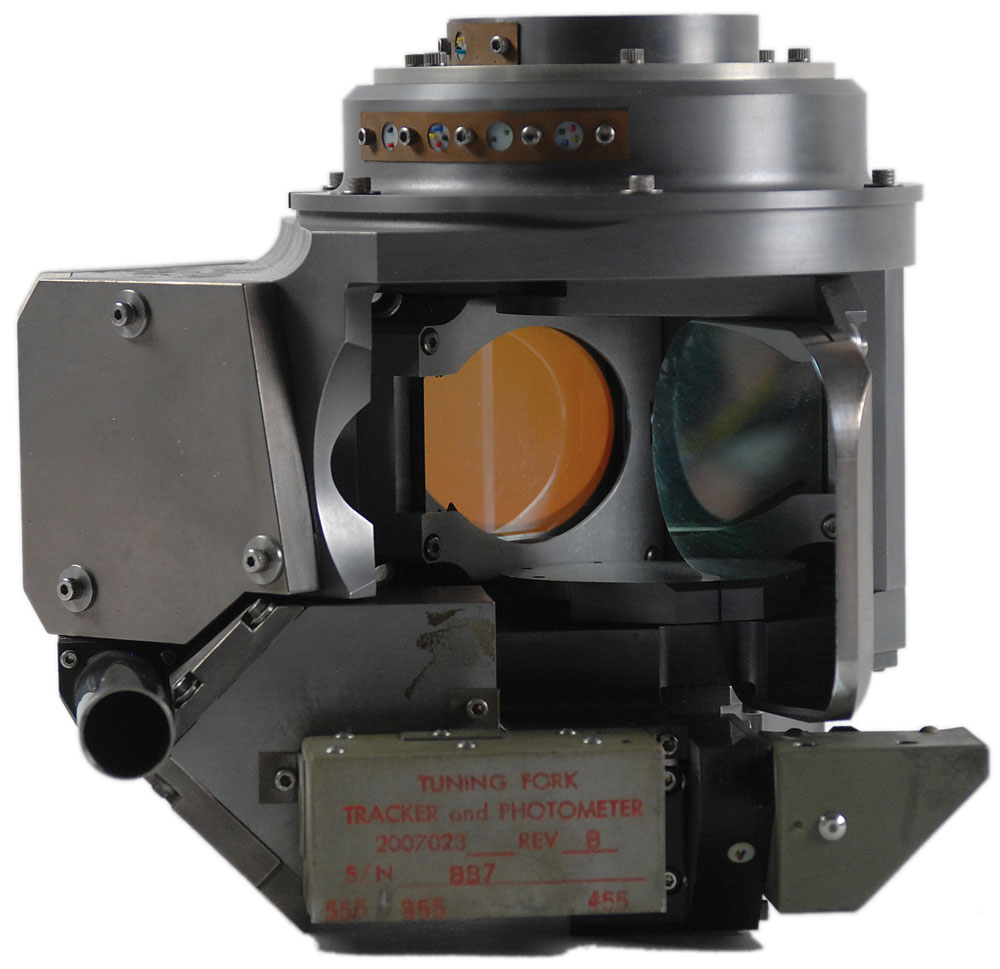
But an inertial platform has a weakness: it drifts. No gyroscope is perfect, and over hours tiny errors accumulate until the platform’s idea of “which way is up” no longer matches reality. The cure is to look outside occasionally and re-establish the truth — which is the job of the second part, the optics. In the Command Module these were two instruments: a scanning telescope, wide-field and low-power, for finding and roughly aiming at stars and landmarks; and a sextant, a precision instrument of 28-power magnification that could measure, very accurately, the angle between a chosen star and a planet’s horizon, or between a star and a surface landmark. An astronaut at the navigation station would center a star in the sextant, mark the instant, and let the angle flow into the computer. Enough such sightings, against stars whose positions were known exactly, and the system could fix where the spacecraft was and reset the drifting inertial platform to match. On Apollo 8, Jim Lovell made better than two hundred such sightings on the way to the Moon, and his onboard solution for the point of closest approach agreed with the ground’s reconstruction to within about two and a half kilometers — a quarter-million-mile journey, navigated by hand and starlight, accurate to the length of a small town.
The third part was the thing this whole series is named for: the Apollo Guidance Computer, the digital brain that tied the other two together. The AGC took the accelerometer counts from the IMU and the angles from the optics, ran the navigation mathematics, figured out what burns to make and when, and — through the system’s control function — actually commanded the thrusters and engines to fly them. It held the programs and the reference data; it was the place where sightings became a position and a position became a plan and a plan became a fired engine. And it spoke to the crew through the panel introduced in Volume 1: the DSKY, the display-and-keyboard unit, where a verb and a noun told the computer what to do and where it answered back in glowing green numerals. Built by the Instrumentation Laboratory and manufactured by Raytheon, weighing about seventy pounds, drawing about fifty-five watts, ticking at a 2.048-megahertz clock and reckoning in sixteen-bit words, the AGC was the smallest, hardest, and most consequential piece of the bargain NASA struck in August 1961.
2.7 Why It Had to Be a Computer
It is worth pausing on the word computer, because in 1961 the choice it represented was not inevitable. Guidance had been done before with analog hardware — spinning resolvers, gears, and amplifiers that solved the equations of motion by physical analogy. Draper’s earlier systems were largely analog. One could imagine an Apollo guidance system built the same way.
But the Moon mission demanded something the analog approach could not gracefully provide: flexibility. The navigation and guidance of a lunar mission is not one calculation but dozens — translunar injection, midcourse corrections, lunar-orbit insertion, the powered descent, ascent and rendezvous, the return, atmospheric entry — each with its own mathematics, each needing to be changed as the mission was understood better and as the trajectory was redesigned. An analog computer hard-wires its equations into its physical structure; to change the calculation you rebuild the machine. A digital computer stores its instructions as data and can be reprogrammed without touching a wire. For a mission whose details would shift continuously across nearly a decade of development, that flexibility was not a luxury; it was the only way the job could be done at all. The decision to make the AGC a stored-program digital computer is, in retrospect, one of the most important Apollo ever made — and it pulled the program, almost inadvertently, to the leading edge of a technology that barely existed.
For that technology was the freshly invented integrated circuit, and the Instrumentation Laboratory’s decision to build the AGC out of these new, unproven silicon chips — at a moment when almost no one trusted them for anything, let alone for carrying astronauts — was a gamble that would help drag the entire semiconductor industry into being. That is the story of Volume 4. Before it, though, we need to meet the people who made the bet: the engineers, programmers, and instrument-makers of the laboratory that won the first contract of the Moon race. That is where we go next.
2.8 What the Decision Bought
Step back and the shape of the choice is clear. Faced with the hardest navigation problem ever attempted, and conditioned by a decade of strategic anxiety to distrust any system that depended on an outside voice, NASA decided in the summer of 1961 that its Moonship would carry a brain. It would be able to find its own way by the oldest method — the stars — fused with the newest — an inertial platform and a digital computer. The ground would help, and in the end would do more of the work than the early plans imagined, but the spacecraft would never be helpless without it.
The decision came first, before nearly everything else, and it went to a university lab whose director would have flown the mission to prove his instruments. That is an unusual way to begin the largest engineering project in history, and it produced an unusual machine. The next two volumes follow the consequences: the Laboratory and its people in Volume 3, and the integrated-circuit gamble that made the computer small enough to fly in Volume 4.
Next — Volume 3: The MIT Instrumentation Laboratory.
Comments (0)